

On 16 June 2026, the Oklahoma 2026 Democratic U.S. Senate Primary Election yielded two winning candidates: one, a progressive, self-described advocate running on LGBTQ+ rights and racial equality whose early campaign advertisements featured her declaring that she would refuse to take money from AIPAC and corporate donors; the other, a zombie from a previous era, a Democrat coming out of political retirement after sixteen years who’s running on affordability and expanding rural public services.
It is my personal view that if the Democratic Party is to have any future as a statewide party in Oklahoma, one of these candidates must win the runoff, and the other must be defeated, not because of who they are or what they believe, but because of who they might win.
We need a candidate who recognizes that Democratic marginalization in Oklahoma is not a fate, but a choice that we have made over a generation of incompetence. We need a candidate who will stand with their party when it is right and buck it when it is wrong.
Jim Priest should prevail over N’Kiyla Jasmine Thomas because he is far more likely to do these things. He’s an old-school Democrat who has these instincts in his political blood. But whoever wins the primary must be prepared to become the moderate populist that we need to contest the general. Whoever wins the primary must decide to win.
Democrats Used to Win Here
Once upon a time, on a land beneath our feet, Democrats used to win.
While Democrats haven’t won on the national level in Oklahoma since the high tide of liberalism in the mid-1960s, the Oklahoma Democrats have a long and storied independent tradition. While the liberals running the DNC never quite figured Oklahoma out, Oklahoma used to have a strong Democratic Party on the state-level that was quite effective at getting its candidates into office. And I don’t mean good at winning back when Democrats were chill with segregation, I mean good at winning fifty years ago, forty years ago, thirty years ago, twenty years ago, and that the last Democratic governor left office during the Obama administration. I mean that Oklahoma used to have governors who supported the ratification of the Equal Rights Amendment, who lobbied for the right of homosexuals to marry, and who would veto abortion restrictions and call them unconscionable.
Were these men “liberals” or “progressives” in the modern sense of the word? No, of course not. These were the type of men who would give rabble-rousing speeches in Walmart parking lots and kept their campaign headquarters in the back of an RV. They were the type who drove around Oklahoma in beaters, waving brooms and promising to “sweep the Old Guard.” They were type who said “Read my lips” but refused to raise taxes. They were the type who signed off on bills to expand the use of the death penalty and told Oklahomans that they could stand their ground. They were the type who declared that the penalties against cockfighting were too harsh because they understood rural indignity at urban condescension. They were not progressives. They were technocratic-liberal-conservative-moderate-populists with strong campaigning skills. But they were a hell of a lot closer to what a liberal or a progressive might want than anyone who’s elected statewide today.
Today, Democrats routinely lose in Oklahoma by large margins. Republicans hold a supermajority in both chambers. The closest the Democrats got to winning in recent memory was when they fell for some polls in 2022 that indicated that 8.4% of Oklahomans were apparently going to vote for “Other” candidates in a two-candidate race.
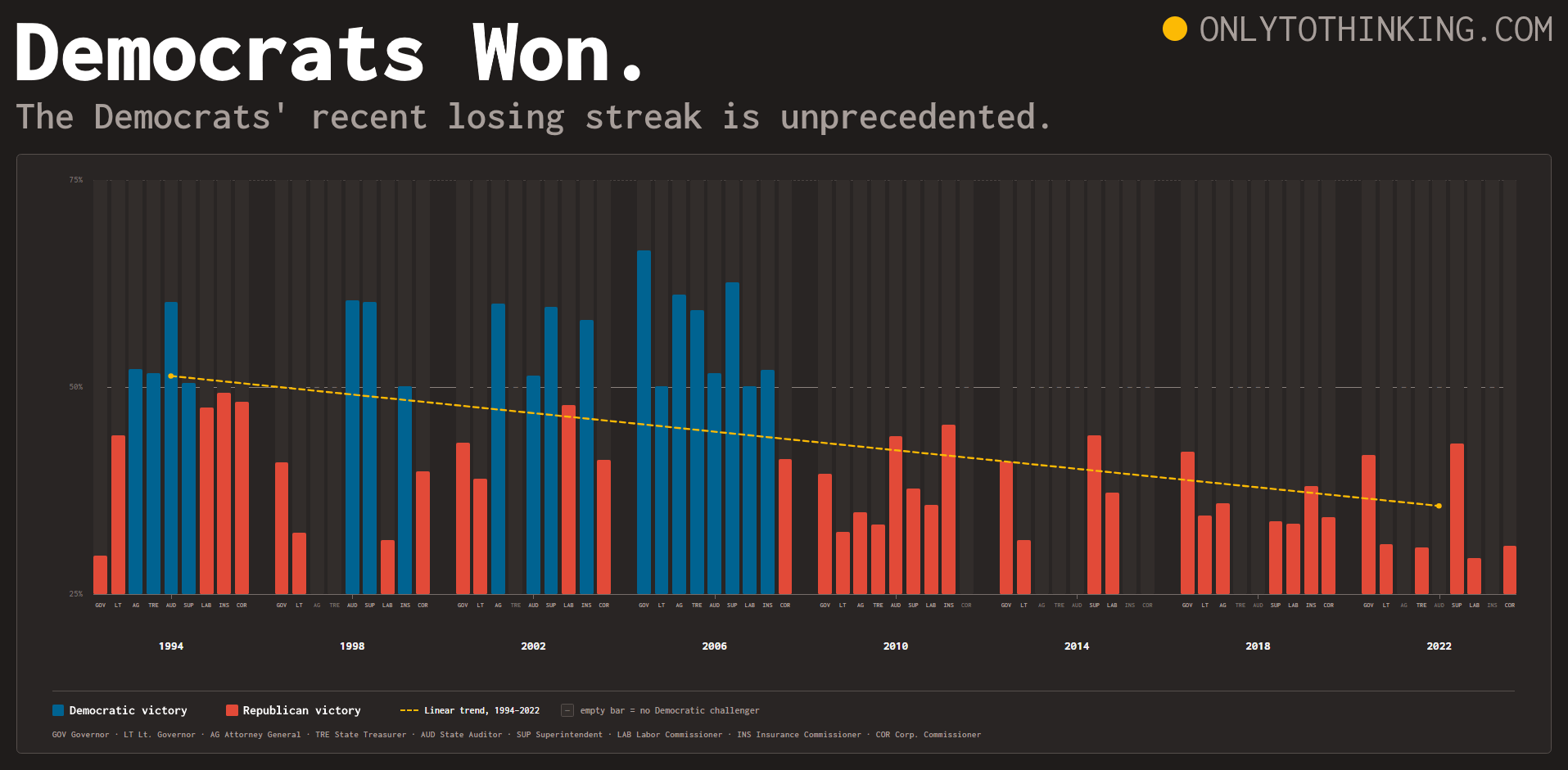
The Democratic share of the vote has declined precipitously. In fact, it has declined so much that a typical Democratic candidate for statewide office in Oklahoma can reasonably expect to lose with numbers that would have been extraordinary before the turn of the century. For example, Republican Frank Keating was elected as governor of Oklahoma in 1994 under circumstances that might be best described as once in a red moon:
After a lengthy investigation, incumbent Democrat David Walters had pled guilty to campaign contribution irregularities and decided not to run for re-election.
The Democratic vote was split 55/45 between the official Democratic nominee and a populist former Democratic congressman, who was able to stick it to the Democratic establishment by sweeping the Southeast.
The 1994 elections at the federal level were among the most consequential elections in American history, the Republicans picking up so many votes and so many seats that it’s often been called the Republican Revolution.
This is what it took for a Republican to win in Oklahoma with a plurality of the vote in 1994. These are the utterly apocalyptic electoral conditions that it took to reduce the Democratic share of the vote to below 30%.
In the most recent election for a statewide office, Democrats won just 28.9% of the vote.
The Myth of the “Poor Democrats”
One sleight of hand that a lot of commentators pull when they discuss the decline of the Democratic Party is Oklahoma is that, whether out of deference to their political allies, courtesy to their sources, or simple self-aggrandizement, they pretend it wasn’t anyone’s fault—at least not the fault of anyone with power.
Take for example this piece from KGOU in 2015, where they chock up Democratic struggles in Oklahoma to “new rules, retirement, realignment, and racism.” Rules just change, don’t you know? There was no way that Democrats could have possibly changed their behaviors and adapted to the term limits that were passed in 1990, implemented in 1992, and then became relevant starting in 2004. There simply wasn’t enough time. And retirement? Well, what would you like us to do? Stop people from aging? One could not possibly seek to actively recruit young, high-quality candidates to seats where they might win, or to establish orderly norms for the transfer of power from older to younger co-partisans rather than throwing leaves to the wind every time someone hits 65. And racism? Well, it’s not our fault if the voters are wrong!
There are many versions of what I’ll call the “Poor Democrats” thesis. One version says that Oklahoma Democrats have been in terminal decline for decades as each new generation of rural, white voters changed their party identification to match their conservative political views. I don’t find this thesis convincing. For one, the timeline doesn’t work. If this were a case of steady generational transition, why was the drop-off so sudden? Why was it the case that Democrats went from contesting Oklahoma to not contesting Oklahoma within the time it took for Brad Henry to finish his second term? Was there a retirement home bomber in Southeast Oklahoma? Did all the old yellow dogs catch kennel cough? I don’t buy it.
Another version says that the Oklahoma Democrats were just victims of the merciless nationalization of partisan politics, and that the same historical waves that turned the Old South ruby red did the same to Oklahoma when it crashed in Little Dixie. But again, I doubt this thesis because, even as working-class voters have left the party, even as white southern voters have left the party, and even as politics has become ever-more nationalized and polarized, Democrats have continued to win in deep red states, especially in state elections where bold politicians are able to actively differentiate themselves. Since Trump won office in 2016, Missouri, Kansas, Louisiana, and Alabama have each elected Democrats at the state-level at least once, and Kentucky and West Virginia, two of the reddest states in the union with a comparable populist tradition to Oklahoma, have done so twice.
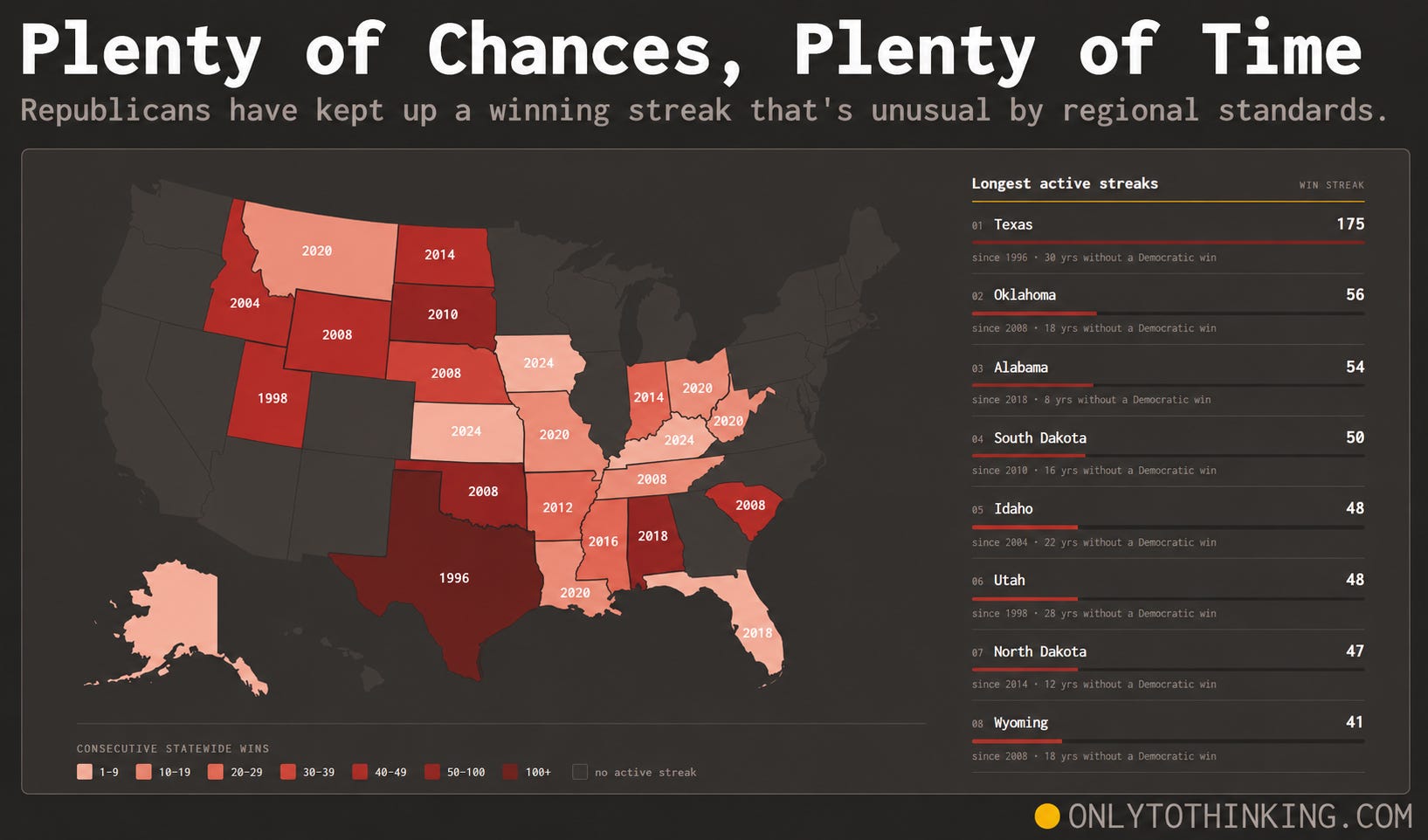
This is a wonderful thesis because it is toothless and impersonal. Everyone wins: Democratic officials don’t need to seriously think about why they can’t win elections in Oklahoma, so they alternate between “educating” the electorate, waiting for favorable demographic changes, and pretending that they are winning, actually. No one gets their feelings hurt, no one loses their job, and no one needs to step out of their comfort zone. It’s an even better deal for the Republicans, who can both keep winning and justify their insane and disproportionate power by just shrugging their shoulders and declaring that Oklahoma is a conservative state.
But let’s be honest in a way that should lose some people their jobs: realignment was not the cause of the Democrats losing Oklahoma, but an effect of their losing touch with it. The problem with the “Poor Democrats” thesis is that it implies that the Oklahoma Democrats could do nothing in response to unfavorable structural change, and that they can do nothing to respond to the new situation they find themselves in. The difference between 1970 and 2020 is not that Oklahoma is any more conservative or that national Democrats are any more liberal. In 1972, the Democratic candidate for President George McGovern was derided by his opponents as the candidate of “Amnesty, Acid, and Abortion.” Oklahoma, in turn, proceeded to vote for Richard Nixon by a margin of nearly fifty points while voting for a moderate Democratic governor.
No, the real problem is simply that state-level Democrats got worse at appealing to the voters that they actually need to win. By refusing to distinguish themselves from a toxic national Democratic brand in any significant way that might win votes, Oklahoma Democrats have ghettoized themselves. They have become the party of the urban professional class in a state where that class is a side character.
It was once the case that the Democratic elite in Oklahoma was a big tent, fractured between state officials, local officials, and urban labor leaders, all running their own political machines to deliver their people into the Democratic column come election day. Ideologically, the party held a portion of the political spectrum that went all the way from snooty urban liberals to redneck rural populists. There was no expectation that Democratic politicians would toe the party-line on any given political issue. They were only expected to win, so they did, with Democratic politicians using their locally tailored, personal appeal to win in whatever districts they needed to. Any petty ideological differences could be sorted out behind closed doors after they had done the important part, that is winning power.
Today, however, there is only one faction of the Oklahoma Democratic Party, and that is the urban liberals and those who agree with them on everything.
The Suicide of the Oklahoma Democrats
It’s time to talk about the dead donkey in the room. There was, in fact, an exact year when Democrats stopped contesting Oklahoma, and that year was 2010.
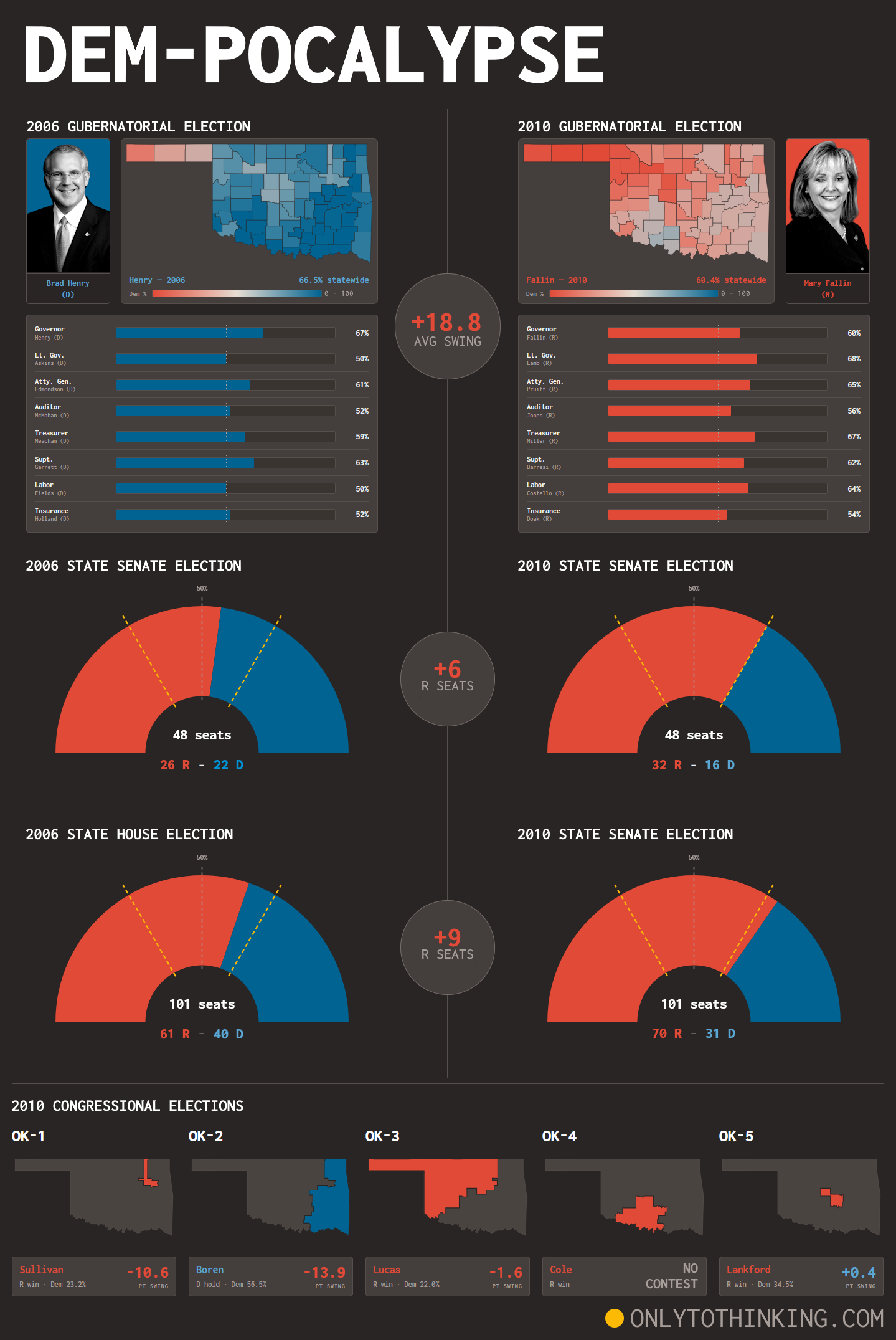
Admittedly, the year of the Tea Party Revolt wasn’t great for Democrats anyway, but in Oklahoma, it was when the old coalition of urban liberals and rural populists exploded.
On SoonerPoll in the days following the election, OU’s political science department chair Keith Gaddie apocalyptically reported on how Democrats had fallen through the floor in Little Dixie, losing every single county in their own backyard in that year’s gubernatorial election—a 27-point swing against the Democrats at the top of the ticket. While the Democratic candidates for Auditor and State Insurance Commissioner put up promising performances, they couldn’t overcome a horrific performance at the top of the ticket. Pollster Bill Shapard argued that the Democratic candidate for governor, Jari Askins, just wasn’t ready for primetime. Outside of her local base in Southwest Oklahoma, she was a weak candidate. While she was nominally conservative, her campaign was too mushy, too little, and too late.
Jari Askins’ campaign in 2010 might well remind readers of Kamala Harris’ ill-fated campaign in 2024. In a contentious election that numerous polls indicated she was poised to lose, she ran a campaign that was so positive it dripped into sappiness. Where Harris had “Brat Summer,” Askins had “Oklahoma: Heart and Soul.” She ran a campaign premised on winning the support of various identity groups that, while effective for a Democratic primary, is ineffectual in a general election. Possibly worse than actually taking a position, Askins most often took no position at all. An Oklahoma voter in 2010 might have rightly wondered what position Jari Askins took with respect to ObamaCare. Her website certainly wouldn’t tell you. Fallin lambasted her opponent for refusing to take popular stances on everything from ObamaCare to gun rights to illegal immigration. For her part, Askins refused to criticize President Obama, even at the peak of his unpopularity in Oklahoma.
The ridiculous thing about Democratic failure to win statewide in 2010 is that a better performance would have cost them nothing. Let’s say, in an alternate universe, Askins took the stances she neglected to take in our timeline: she stood up for the rights of gun owners, she criticized illegal immigration, and she called Obama a lib. What would it have cost her? She wasn’t running to be Oklahoma’s Supreme Court Justice or Oklahoma’s border security czar or Oklahoma’s delegate to the White House. She was running to be Oklahoma’s governor, a figure who would have little to no say over any of these issues. Oklahoma doesn’t share a border with Mexico, so she could be excused for doing as much as any inland governor was doing on immigration in 2010: not much. On ObamaCare, she wouldn’t have had any authority on whether or not it became law, so she’d have her hands conveniently tied there. She could save a political fight over Medicaid expansion for the second term. Thus, by process of elimination, we find that her role in actively claiming the center for the Democratic Party would effectively amount to not actively violating the Second Amendment of the Constitution. That’s it!
On the same day Askins got trounced, Joe Manchin over in West Virginia was running for his first Senate term, and he was running to win. His signature ad of the campaign featured the following copy:
I’m as mad as you are with what’s going on in Washington. Both Democrats and Republicans are dead wrong. They put their party first, their personal agenda second, and their country last.
He was suing the EPA over new coal regulations. He talked about taking the fight to the administration. He talked about killing cap and trade and then shot it with a rifle while a banjo simmered. Guess what? He won, and twelve years later he would cast the decisive vote in favor of passing the most consequential piece of climate legislation in American history.
But there are even more compelling examples of what actually trying looks like closer to home. In 2010, the Democrats were fortunate enough to hold on to Oklahoma’s 2nd by virtue of the moderate maverick Democrat Dan Boren. Back in 2008, Dan Boren never endorsed Obama, calling him too liberal and criticizing his lack of bipartisan credentials. Then, he voted for Obama at the Democratic National Convention, voted for Obama for President, and voted with Obama more than many Democrats and far more than any Republican.
And who replaced Blue Dog Boren after he retired at the shockingly young age of 39? Well, the infamous right-wing nutjob Markwayne Mullin, of course! The man who had the infantile composure necessary to be rage-baited by the Teamsters at a Senate hearing; who had the moral courage to be the face of the opposition to releasing the Epstein files; who had the sycophantic deference necessary to be confirmed as Trump’s Secretary of Homeland Security by the closest vote in the history of the office, started his career after Oklahoma Democrats either failed to keep Boren from retiring or, perhaps more accurately, failed to stand with him in the face of insane and defamatory liberal attacks, even culminating in a left-wing attempt to throw him out during the 2010 primaries.
The theme of the 2010 elections in Oklahoma was a growing Democratic disconnect from reality. In an editorial published by the Guardian in 2009, liberal pundit Michael Tomasky dared to ask the question “How nervous should those Blue Dogs be?” before making a long list of seats held by Blue Dog Democrats in 2009, including Dan Boren’s OK-2, that Democrats have almost all lost as of 2026. “A very clear majority of these people have won by large enough margins that it sure seems to me they could survive one controversial vote if they put some backbone into it,” he insists. Well, apparently, they couldn’t even survive not taking controversial votes.
In celebration of Dan Boren’s retirement, the right-wing publication Oklahoma Constitution reached out to the liberal who attempted to throw Boren out of office in 2010. He reported that he still believed that Boren lacked “the progressive values needed in CD-2.” I must imagine that the writer for Oklahoma’s leading conservative magazine of record was giggling with delight at the other end of the line. Since Boren’s retirement, a Democrat hasn’t even come within 19% of winning CD-2. I suppose they just haven’t been progressive enough.
Are you starting to see a pattern here? This isn’t any old battlefront, it’s a pincer maneuver. When leftists have their way, they get Democratic candidates who can’t win in Oklahoma. Put another way, when leftists have their way, Republicans get Democrats who can’t win in Oklahoma. In either case, Republicans and leftists find themselves in a peculiar alliance against the electoral interests of the Democratic Party.
If I were to summarize the last sixteen years of Oklahoma politics, it would be with this dynamic. 2018 is an instructive case here. Consider a piece released in 2018 by KOSU where the authors provided favorable coverage to two Democratic candidates who sought to win a senate seat in Lawton by trying to “increase Democratic turnout in November” and ran on paying for an increase in public education funding with a tax hike. They lost, of course, to a moderate Republican. That same year, state and national media outlets were hyping up a “Democratic comeback” in Oklahoma in the context of a supposed “red-state revolt” against poor teacher salaries, and the party base rallied to throw a big bag of Progressive teachers into an electoral meat grinder against moderate Republican incumbents. The results? +3 seats in the Senate, -2 seats in the House, and losing the governorship by 12 points to the man who would impose the nation’s strictest abortion ban and establish a program of state subsidies for private schools.
And during this whole period, instead of making inroads among the rural voters that Democrats would need to actually win in Oklahoma, the Democratic Party has only become more and more entrenched among the very voters whose support it least requires. It has become a party of urban progressives in a rural conservative state.
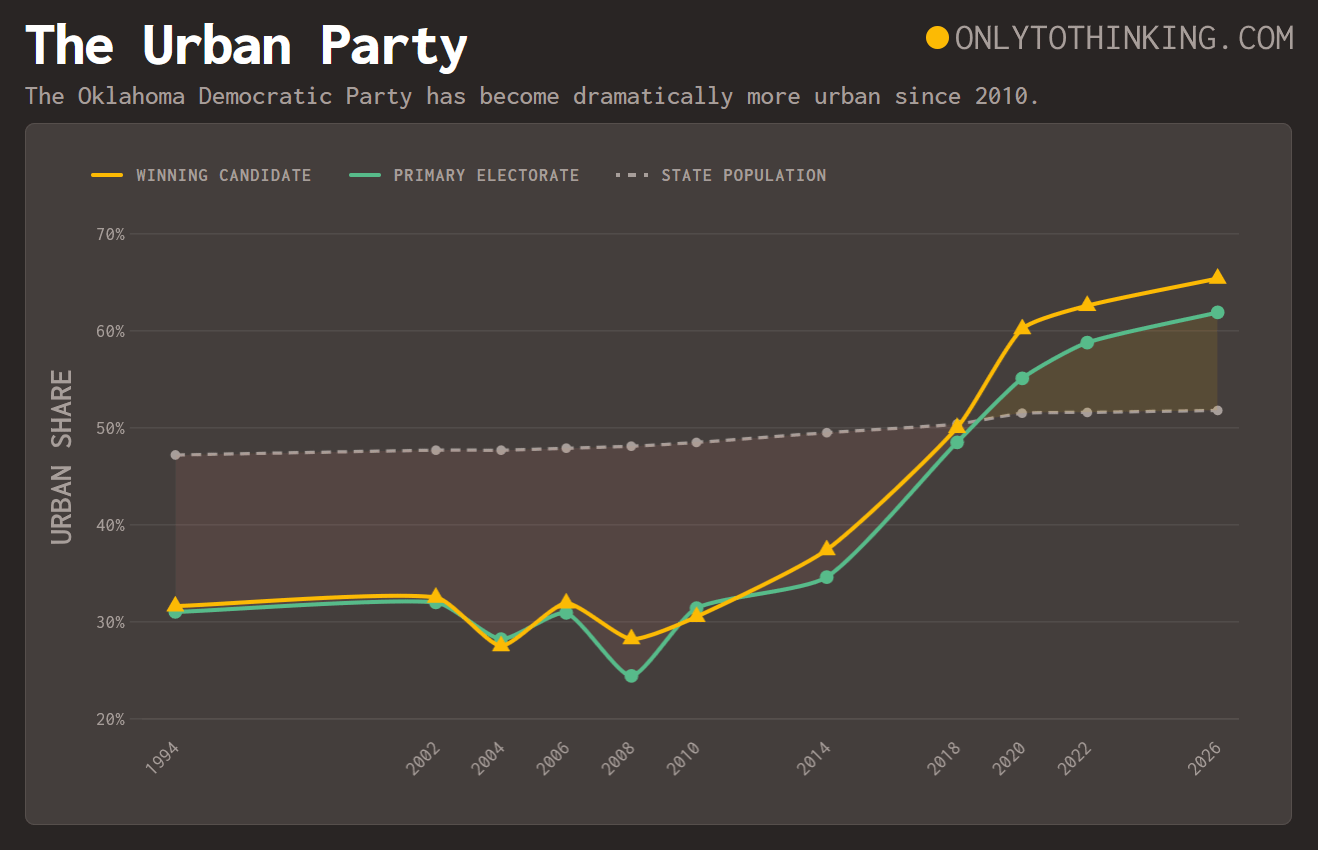
This is what the collapse of a political party looks like on a chart. The pre-2018 Democratic Party had a powerful rural wing that was able to effectively discipline the excesses of the urban liberals. After the Askins campaign went down in smoke, a rapid and decisive process began: for the first time in the history of Oklahoma, the Democrats would be an urban party.1
Enter Stage Left, N’Kiyla Jasmine Thomas
N’Kiyla Jasmine Thomas entered a Democratic Party that had already been fundamentally transformed by the defection of the rural faction over a decade ago. Thomas would have been ten years old during the last hurrah of the old Democratic Coalition in 2006, and she likely only has vague memories of the last Democratic administration to govern Oklahoma.
Thomas is campaigning for Senate in Oklahoma in the same way that a progressive challenger to a Democratic incumbent in a major blue city might, which is to say that she campaigns on issues that lack salience to actual Oklahoma voters. She laments “price gouging” in a state with the lowest cost of living index score in the union. She campaigns on “the living wage” in a state that just rejected a $15 minimum wage by almost ten points. She declares she won’t take money from AIPAC in a state that has more evangelicals than it does Muslims or campus liberals. She has an affinity what might be best described as wokeness, like “fighting for LGBTQIA+ rights” or weird ethnonationalist rhetoric about her “unique and powerful perspective” as a mixed-race woman.
This isn’t to say that any of these ideas are bad ideas—though I certainly have my views. It is simply to say that these ideas are bizarre for the context in which Thomas finds herself. She is an embodiment of some of the worst neuroses of the modern urbanized, Oklahoma Democratic Party, for, make no mistake, she is their candidate. In last June’s primary, she won ten of the top twelve richest counties measured in terms of per capita income. She won nine of the top twelve most college-educated counties, and she won all nine of the densest counties.
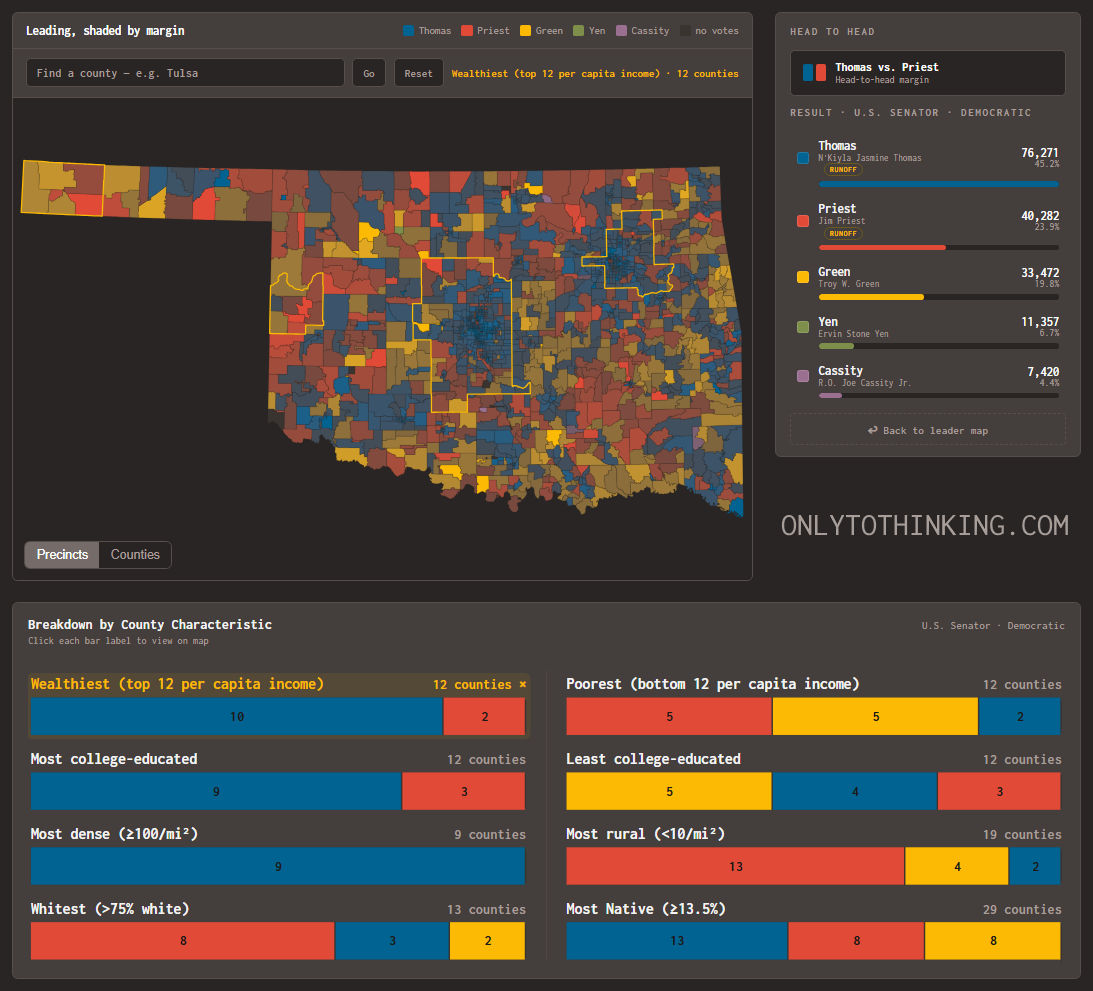
Perhaps most damning of all, she has the single most urban coalition of any Oklahoma Democrat in the history of the state, with 69% of her voters deriving from Oklahoma’s five most urban counties. For Cyndi Munson, this number was just 63%. For Oklahoma’s last Democratic governor, it was 32%.
Since she only won 45% of the vote, she will be advancing to a runoff where she will face off against Jim Priest, while not the most rural or the most moderate candidate on the ballot, is certainly more moderate than Thomas. He’s endorsed by David Walters and Brad Henry, two previous Oklahoma Democratic governors, so that’s a pretty good start, but I’ll come back to him later.
For now, let’s just think this through. Let’s say, come next month, N’Kiyla Jasmine wins the Oklahoma Democratic primary. Let’s say she coasts off her existing coalition and there’s nothing to shake up the race in any fundamental way: rural Troy Green and Joe Cassity voters mostly consolidate around Jim Priest, urban Ervin Yen voters mostly break for Thomas, and Thomas takes advantage of the high turnout rates of her well-educated base to win with around 55% of the vote. At this point, if she’s really interested in running a general election campaign, she’ll have two real options:
A) Walk back all that silly nonsense that she’s been campaigning on for the past year. She could pull a Talarico and downplay some of the most ridiculous parts of her record; hope that enthusiasm for her campaign will translate into a couple down-ballot flips in marginal state elections like HD95, HD100, and SD34; try to build an organization and a volunteer list that can be mobilized for future Democratic campaigns. She could give Democrats something to live for.
B) Be the prettiest sacrificial lamb she can be. She could say all the right words to bring in money from all the progressive donors all across the country whose hearts are bigger than their brains; let her co-partisans in the House and Senate dry out in the Oklahoma heat; get defeated by R+40 in every county, and then blame it on the Democrats. I’m not describing some fantasy of what progressive politicians do when they run on unelectable ideas in deep red states. I’m describing what Paula Jean Swearengin did in West Virginia in an election where she underperformed Biden.
For my money, given the clout-chasing nature of her campaign so far, I think she would lean towards the latter option. I do not trust that Thomas would be a team player and put aside her least popular views to try to win a red seat. Maybe I’m wrong, but I predict that an inexperienced political candidate who prides herself on friendly Facebook comments will not have the wherewithal or the pragmatic impulses to do what is necessary to drag Oklahoma any closer to where she would apparently like it to be. She will run her general campaign exactly as she has run her primary campaign. She will lose decisively to Kevin Hern. She will blame everything and everyone for her loss: media bias, unfair elite coordination, election rigging, or anything else. She will soothe the Democrats as they lick their wounds and assure them that they don’t need to change.
Deciding to Win
In a revealing 2002 article for the journal Oklahoma Politics, Jeffrey Birdsong predicted that Oklahoma was entering into a new era of two-party competition on the state level. He predicted that, due to the effects of term limits, growing fundraising demands, migration into Oklahoma, and increasing concentration in urban areas, urban and suburban Republicans would soon become dominant in Oklahoma’s politics.
Interestingly, he was bullish on the Democratic Party in this new Oklahoma. While he argued that Republicans would be generally favored due to their historical strength in urban and suburban areas, their dominance would never be as total as Democratic dominance was during the peak of their influence in the 1930s. He predicted that Democrats, acting out of their own sense of electoral self-preservation, would seek to centralize while establishing a state brand independent of the ailing national party, which would help them to hold together their coalition in the face of increasingly unfavorable demographics. He argued they would “walk the tightrope of being independent of the national party, yet at the same time supporting the party so as not to alienate partisan supporters in their districts.”
He knew that this was possible because it was exactly what the Democrats had been doing in one form or another for decades. Between 1963 and 2002, or what Birdsong called the “Modern Phase” of Oklahoma politics, Democrats and Republicans each held the governorship for twenty years, and Birdsong likely felt vindicated in his thesis when, in 2002, Democrat Brad Henry narrowly won the governorship without winning any of Oklahoma’s most urban counties.
A rising tide lifts all boats, and a receding tide beaches them. In Oklahoma, the Democrats have been beached. It’s not simply that the rural Oklahomans have left the Democratic Party behind, but that everyone has left. While Oklahoma Democratic Party registration has fallen by nearly two-thirds in rural counties, total registration in Oklahoma’s urban counties has fallen by nearly twenty percent, even as the population of these counties has grown. Democratic registration in urban counties, the very counties that Oklahoma Democrats are supposed to be dominating under their blue-dot strategy, has been stagnant since 2018.
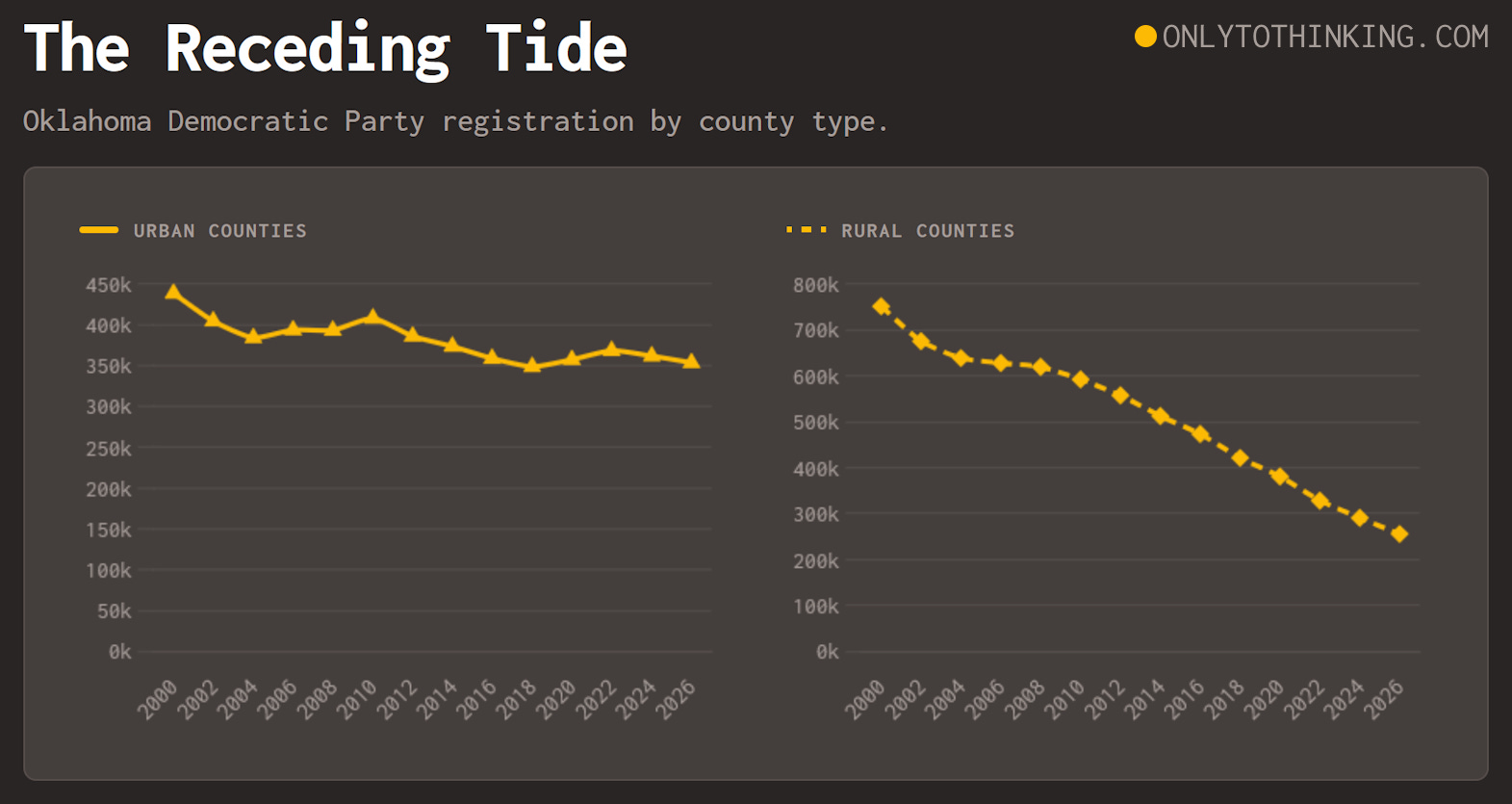
My theory for this decline is simple: Oklahoma Democrats, and those who might be open to becoming Democrats, do not find the party’s record inspiring. Urban liberals might be the only people left in the Oklahoma Democratic Party, but they like winning just as much as anyone else. There is simply no reason to register to vote in Oklahoma Democratic primaries if you know that you’ll always be choosing the losing dog. In the past, I have advised my friends to register for the Republican Party if they want to have a voice in primary elections, which are, all too often, the only elections that matter in this state.
There is simply no reason to officially declare your support for a party that has seemingly decided it has no interest in winning, that prefers narratives about self-pity and unearned stigma to actual strategies that might dig them out of their grave. When a reporter asked Jari Askins in 2010 why she lost the election, she simply replied “Well, I just couldn’t convince the people of Oklahoma that the ‘D’ after my name stood for Duncan.”
I hope that I have demonstrated that this mindset is bunk. In the very same election that Jari Askins refused to criticize progressive national Democrats and lost, Dan Boren did, and he won. It doesn’t make a dime’s difference how progressive you are: even if you find the blue-dog pill hard to swallow, it’s surely easier to pass than the red one. Remember who replaced Dan Boren.
Contrary to the mythologization that one might hear in the media, we actually pretty well know what it takes to win an election: it takes moderation in the eyes of the electorate, defined as one’s willingness to break with one’s party on issues that are important to voters where party orthodoxy is unpopular. For a prominent example, consider Donald Trump, who campaigned against Republican orthodoxy on many issues and was able to win the popular vote in 2024 despite his personal unpopularity. He denounced foreign wars, promised to protect Social Security and Medicare, and took an ambivalent posture towards abortion: all things that you would expect a smart Republican candidate to do if he wanted to win in swing states.
Democrats don’t need to campaign on stopping foreign wars, protecting Social Security, or securing abortion rights because these are things that voters already know that this is what Democrats do. They don’t need to be reminded. What they need to hear is that Democrats will prevent humanitarian crises at the border and deport immigrants who commit violent crimes in this country. They need to hear that Democrats will be both tough on crime and tough on the causes of crime, that they will ensure that police and prosecutors have the means and the will to keep the public safe from those who prey on them. They need to hear that Democrats will not create policies that increase the rate of inflation or make life more unaffordable for those who have the least, such as deficit-financed boondoggles or harebrained regulatory schemes. They do not want to see increases in the price of housing, energy, groceries, and transportation.
On his website, Jim Priest talks about how he wants to keep rural hospitals open and invest in rural communities. That’s a start, but it’s not enough. Back in 2010, one reason Dan Boren was able to survive the red wave was because he was willing to consistently stake out maverick positions that were relevant in his district. He talked about how he had worked to ease regulations on farm trucks and reform the Endangered Species Act, two issues that were relevant to his rural constituents, bipartisan, and toxic to his Democratic colleagues who needed to stay in good standing with the Sierra Club.
I would not, at this stage, advise Jim Priest to update his public policy views to show off his moderate credentials—he needs to win the Democratic primary against Thomas as surely as he needs to defeat Kevin Hern in the general. I would however expect that, come the general election, he fights to win the majority of Oklahomans, not just the majority of Democrats. For my two cents, here are some things that I might run on if I were a Democrat trying to meet the median Oklahoma voter where they are:
Be pro-energy without apology. National Democrats might be deep in the pockets of suicidal environmentalists, but an Oklahoma Democrat should be arranging photo ops next to the drilling operations that he’s vowing to protect and expand. Oil and gas is a leading source of jobs and revenue for Oklahoma, and responsible advocacy for the expansion of industry for the good of the workers and the people is in no way inconsistent with any coherent vision of center-left governance. (See the NDP in Alberta and the Labor Party in Norway)
Be a Patriot. An Oklahoma Democrat needs to keep his hand on his heart for every rendition of the national anthem, from the first “Oh say” to the last “E” of “Brave.” Winning in a red state means loving liberty more than land acknowledgements. It means cocking a rifle like John Barrow and singing “America the Beautiful” like Rob Sand. It means not being so bitter, blasé, and irony-poisoned that he can’t save some love for the country that gave him everything. A Democrat who can’t love this country has no place trying to save it.
Be a candidate, not a stooge. Every fight in Oklahoma between a Democratic candidate and a Republican candidate is going to be tilted against the Democrat, especially now that the Democrats have spent the past decade and a half making their party inhospitable to moderates. Fine. Don’t be a Democrat, or at least be a Democrat second. If a candidate can make every single race into a personal referendum on themselves, then they can win it so long as they know themselves. (See Osborn in Nebraska for recent innovations here)
For the upcoming senate race in particular, this last point is relevant. Representative Kevin Hern is not a clean candidate. Jim Priest and N’Kiyla Jasmine Thomas both possess the opposition’s luxury of never having been in government. Kevin Hern, on the other hand, has eight years of scandal and impropriety behind him. He has violated the STOCK Act by failing to properly disclose between 4.2 and 17.6 million dollars in stock trades. Hern is apparently a deficit hawk who supports a balanced budget—but he was more than happy to take over a million dollars from the federal government when he got his turn at the dole. The guy spends most of his time in Washington handing out McGriddles to anyone who will endorse him for higher offices, whether it be the majority leadership, the speakership, or, now, Oklahoma’s senator.
The guy has nothing but a Trump endorsement and an (R) next to his name. A good candidate who’s able to tell Oklahomans what they want to hear might not be able to win, but they’d be able to make an announcement: Democrats are back. Democrats are tired of sitting in the opposition. Democrats want to turn Oklahoma from “Solid R” to “Lean R” to “Swing,” not because we want to join whatever social engineering project those urban liberals are getting up to in California or New York, but because we are interested in a bipartisan government that is accountable to its constituents more than we are interested in the antics of the supermajority.
I don’t think Thomas can do it. She is the urban progressive candidate who appears to believe she can win in Oklahoma as surely as Mamdani could win in New York, and I doubt her thesis to the core. Oklahoma is not New York. Mamdani did not win in New York because progressives can win everywhere; he won in New York because he was a good candidate for New York. Oklahoma does not need a cookie-cutter template from another state imposed on our own context. We need candidates who are good for Oklahoma.
But I think that Priest could do it. Priest has won the endorsement of the establishment that once won. He is, I concede, a veteran of the losing class of 2010 where he lost by thirty points. In this case, I consider this not a detriment, but a benefit: he knows what it is like to win because he was recruited by a winning party, but he knows what it is like to lose. He knows how much it costs, how much it hurts, and how much can be hurt when radicals prevail. In 2010, he warned against turning Oklahoma into a partisan lawsuit factory. Then, for six years, he watched as his opponent did just that, proving himself such a loyal partisan lawsuit manufacturer that he was appointed to Trump’s cabinet where he proceeded to line his pockets. Priest of all people would know why he needs to win this November and why it’s worth bucking his party to do it.
But it starts with deciding to win. It starts with making sure that Oklahoma’s values and concerns are the ones represented by its Democratic Party. We want to create a world where every Okie knows that a vote for a Democrat is a vote for competent, moderate, pragmatic governance by someone with the interests of their constituents carved into their heart and written into their record. In an imperfect world with imperfect candidates, running under the banner of a hollowed-out party in a deep red state, Priest is the closest we can get in this election.
Urban is defined here as deriving from the five counties that have maintained an average population of over 100,000 since 1990: Oklahoma, Tulsa, Cleveland, Canadian, Comanche.
Wow, this was great, and I found myself agreeing with everything you said! And so much of this applies to how Democrats have operated in other very red states such as Montana (Alani Bankhead, the Democratic Senate candidate this year, is an awful fit for the state).
Brayden, I have a random question for you, since your knowledge of Oklahoma politics is second to none. In your view, how did Kendra Horn flip OK-5 back in 2018?
It remains my favorite upset to this day, but I never sensed that Horn was an exceptional candidate (or that her opponent was weak, which he wasn't). Was it maybe just that Oklahoma City voters finally started behaving more like other urban/suburban voters in 2018?