


It is conventional for people who think a lot about politics to think of civic institutions in a spiritual manner. In the previous three Democratic presidential campaigns, each candidate argued that the presidential election itself was a “battle for the soul of the nation”—this rhetoric from the more secular of America’s two major parties. The Catholic intellectual Joseph Bottum has argued that the collapse of the Protestant mainline is a key cause of political vitriol. Whereas churches once trafficked in dread and desire, now politics is the mule. In one episode of The Ezra Klein Show, Klein read back to Ross Douthat his description of Donald Trump as “a figure touched by the gods of fortune in a way that transcends the normal rules of politics.” The two columnists proceeded to talk fortune and divinity. They debated what it means to regard Trump as a mystic or a great man of history.
American politics has taken on a theological dimension, and in the past thirty-six hours, I have been drawn toward hadith. Bill Moyers was Lyndon B. Johnson’s chief of staff. On 2 July 1964, LBJ turns to Moyers on the presidential aircraft and casually remarks “Well, I think we may have lost the south for your lifetime – and mine.”
Bill Moyers died last year. This morning, the Texas Tribune is reporting that the Democrats are going to be the majority in the Texas House of Representatives for the first time in decades.
In 2016, during the hottest months of the Republican primary that would choose Trump, Lindsey Graham remarks that “If we nominate Trump, we will get destroyed, and we will deserve it.”
Now, a Democrat is going to sit in Lindsey Graham’s old seat.
Just think: in two months, the Democrats may hold:
The largest majority in the House of Representatives since 2008
A 56-44 Senate majority, off the largest seat gain since 1958
30 governorships, covering 75% of the population of the United States
14 additional state legislatures and 7 veto-sustaining minorities
Governor Ron DeSantis of Florida is describing this election as “an extinction level event.”
But are these swings extinction level? Was victory a prophecy? Is 2026 the final year in the Republican Mayan Calendar?
The sober answer is no.
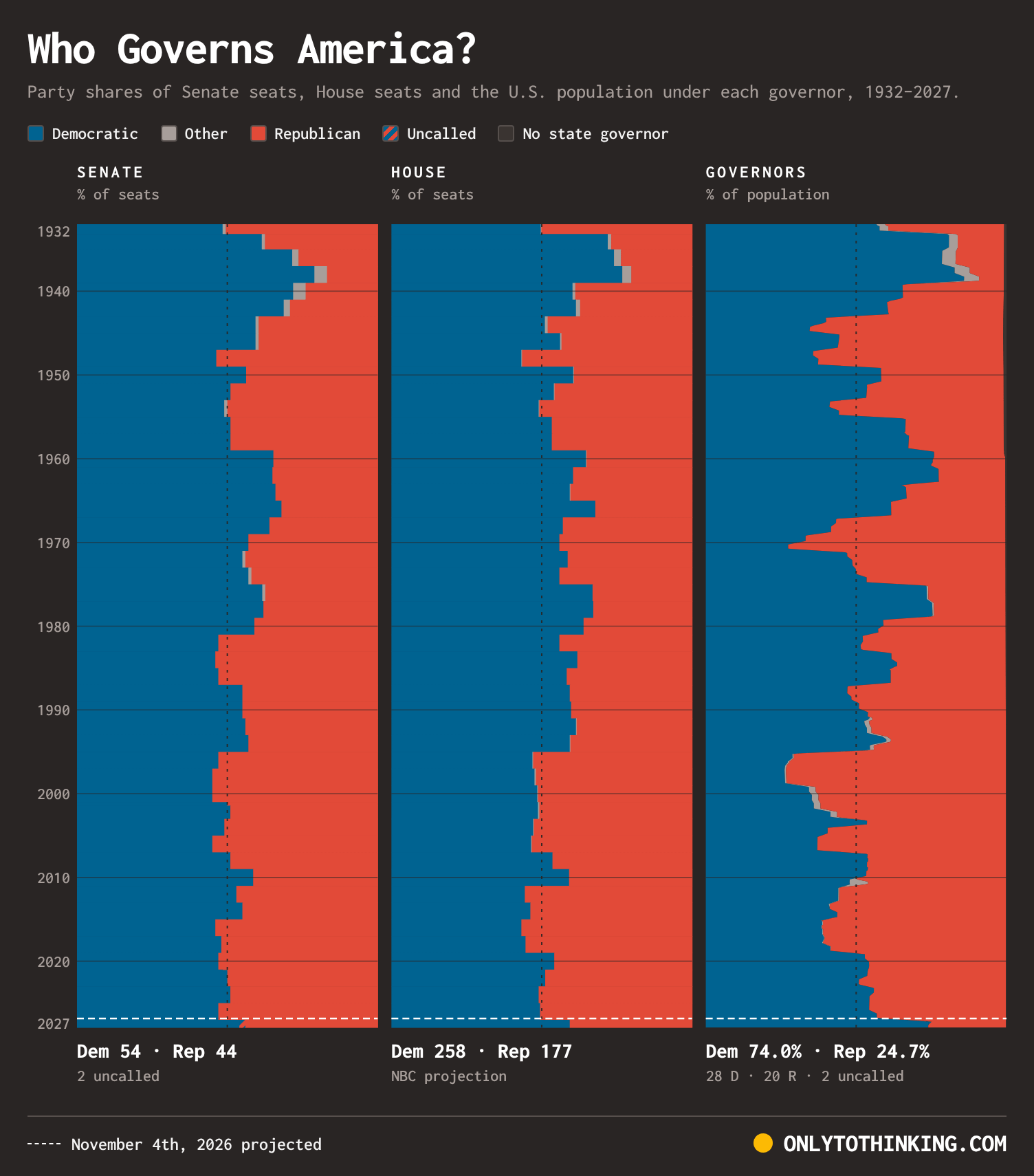
The American electorate swings wildly between our two ancient parties. On Tuesday, the Democrats won the center and won the map, but American history since FDR shows that even sweeping victories are within expected ranges. For the next couple of years, Democrats will be dominant, but dominance is term-limited. In 1978, three-quarters of Americans lived in Democrat-governed states. In 1980, they voted for Ronald Reagan. In 2008, Obamanation: Missouri is too close to call. In 2010, the Tea Party: Republicans win Illinois.
Ross Douthat’s man of history is more compelling in literature than in history. Trump is bound by gravity. He was elected president twice against two weird and unpopular Democratic candidates, and now he’s lost two midterms—badly. Other would-be oracles have fared little better. LBJ would be the first in a string of three southern Democratic presidents. Lindsey Graham would coordinate with Trump to engineer the Iran War.
Apocalyptic political claims are almost always ridiculous because politics is un-apocalyptic. In a functioning society, politics averts apocalyptic outcomes before they happen. Apocalypse cannot pass committee: it can’t even make the agenda.
This isn’t to say that elections mean nothing: for the next two years, this one will mean something. What is questionable is whether it will matter in ten years, whether it will have earned the hullabaloo, the punditry, and the memes about Woke 3.0.