


When Dusty Deevers got elected as one of Lawton’s senators in 2023, it was weird.
Lawton is a hub for moderate conservatism in Oklahoma. The city is perfectly split between districts in the House and the Senate such that our purple dot can make six red districts, four in the House and two in the Senate. Nonetheless, these red representatives appear to act according to the moderate dispositions of their median constituent, Daniel Pae being the most famous example of this. I’ve written previously about how Daniel Pae, a strong moderate, outperformed Donald Trump in the 2024 general election, whereas Rande Worthen, a member of the informal, right-wing House “No” Caucus, performed relatively poorly. Lawton’s other senator, Spencer Kern, a rhetorically moderate businessman from Duncan, defeated “Oklahoma First” Rick Wolfe during SD31’s 2024 Republican primary elections.
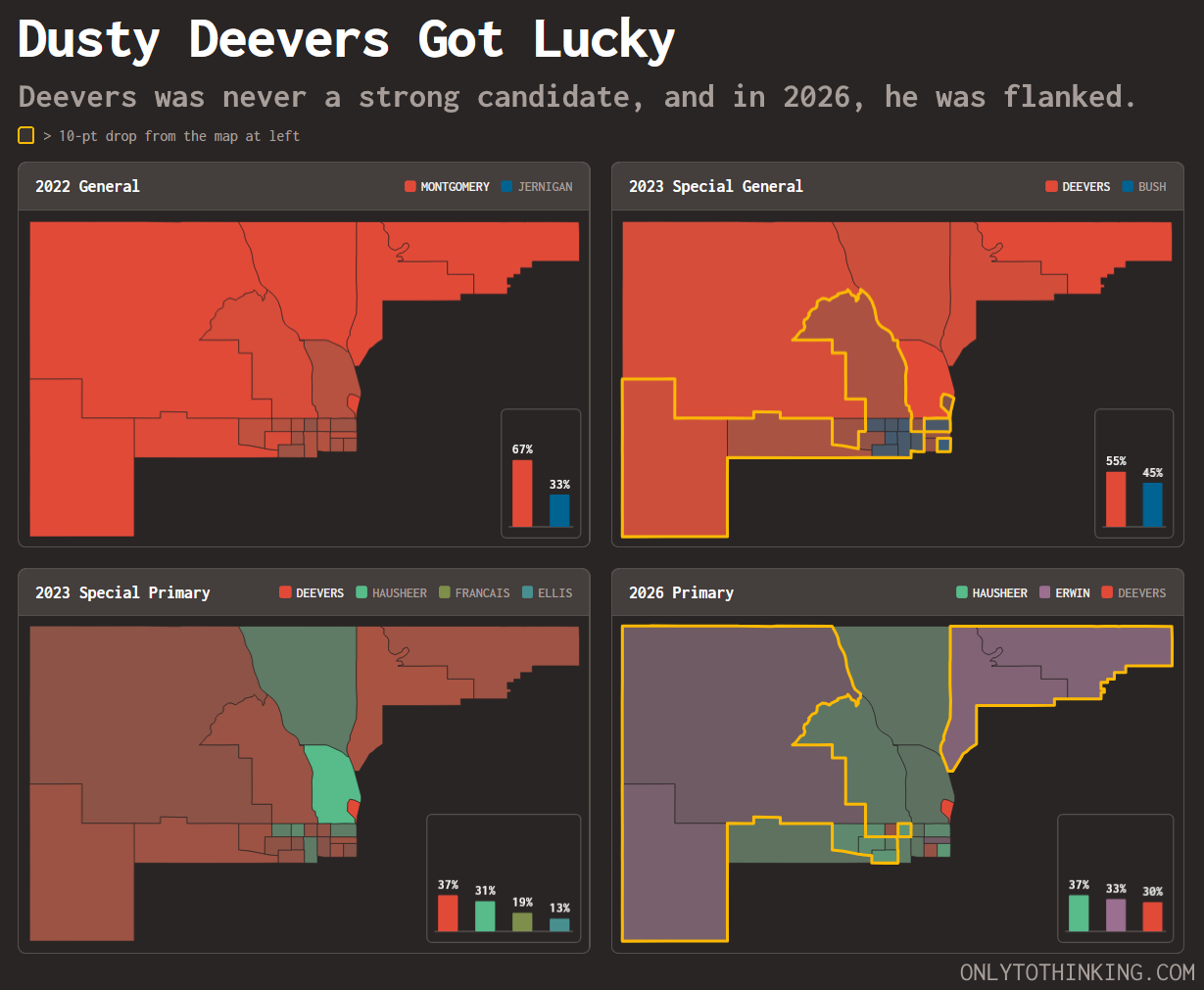
Senator Deevers, on the other hand, was an oddball from the start. Elected in 2023 following the resignation of the previous moderate senator, Dusty Deevers, a pastor from Elgin, won the primary with a plurality of the vote and became the Republican nominee for Oklahoma’s most Lawton-y Senate district. Why a plurality? Oklahoma does not require a runoff for special elections. He won the general election by 12 points less than his moderate predecessor had just the previous year, declared “To God be the Glory!”, and took his seat.
Senator Deevers came into office with a notion of government as simple as it was utterly facile, that the purpose of government is to reward good and punish evil.1 I am not exaggerating; I’m quoting him in a speech he gave to the Center for Baptist Leadership in 2024. And I did not find this quote because I went digging for Dusty disses online (not that they’re hard to find). I found it because he presented me with a version of the philosophy that he outlined in that speech each time I entered into his office during my internship at the capitol a couple years ago. When I was tasked to write a brief biography about Senator Deevers for a public meet-and-greet, on explicit instructions from his office, I published the following:
Dusty Deevers is the Senator for Oklahoma’s 32nd district, encompassing Lawton and its surrounding towns. Born in Elgin, he has received a masters in divinity from the Southwestern Baptist Theological Seminary and serves as a Pastor for the Community Church of Elgin. He also owns his own real estate business, Deevers Properties. This session, Deevers has proposed legislation to prohibit pornography, reclassify abortion as homicide, and abolish the income tax.
Some introduction!
But this is who Dusty was. This is how he wanted to be perceived. He would argue with lobbyists over whether their conversations with him constituted a corrupting influence. He writes serious essays on theology on X and in magazines. When he first took office, he hired Brady Butler as his assistant, a bookish libertarian with a love for longshot lost causes like Federal Reserve reform and the FairTax. His first task for this assistant was to comb through the Constitution of the State of Oklahoma to see if he could find some forgotten clause that they could summon to bring about a right-wing revolution in Oklahoma, as if laws are what is written rather than what actually is. Whenever I first met Dusty, his first question for me was not who are you or what do you do, but “What do you believe?”
He lived in a world of Platonic forms, of Bible verses, of moral theory. He believed in the world of his imagination rather than the world as it was presented to him. He was suspicious of me and my former boss, Representative Pae, for our pragmatic approach. By the end of my time at the House, he was learning. He was making friends with the men who would go on to found the Freedom Caucus and fraternizing with the Democrats, with whom people like him could occasionally form common cause against the mainstream Republicans of the Senate.
I don’t think Senator Deevers sought to become the star that he did, but he stuck out because it was impossible not to notice him. I don’t think he sought to provoke. When he so forwardly expressed his political views and made proposals according to those views, I legitimately believe that he saw himself as fulfilling his sacred obligation not to lie.
But democratic politics has a way of purging such men. In order for the rest of us to live in peace and freedom, it is necessary for those in our government to possess the will to succeed and the grace to compromise. In our system, to ensure that our government is composed of such men, we tie our politicians to the ground. We force them to convince Joe Schmoe and Jane Plain to put them into office, and we make them come back to these randos every few years to check that they’ve done something worthwhile. Our system is not designed to empower high-minded dreamers, but practical-minded people who can write bills, pass bills, and then tell their constituents about all the bills they’ve passed.
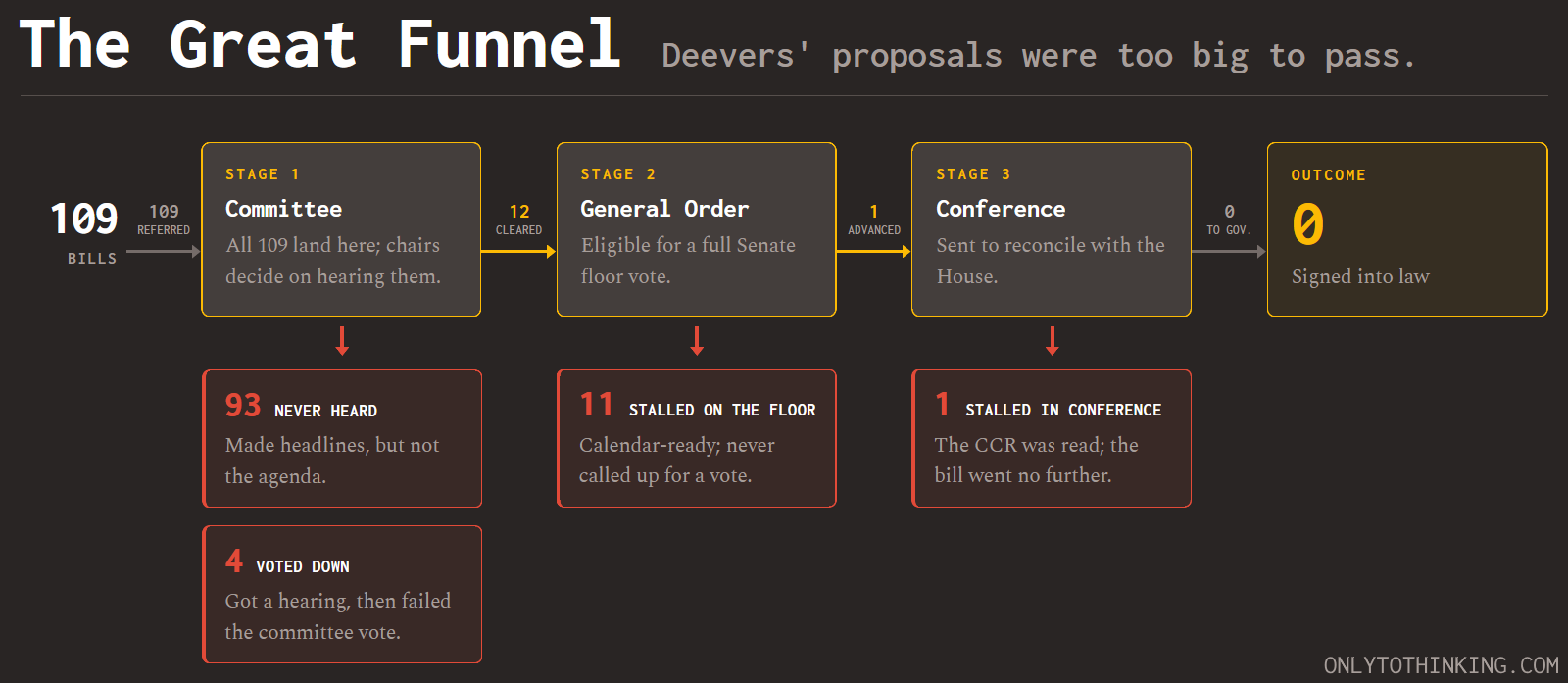
Unfortunately for him, Deevers was uniquely ill-suited for this task. Of the 109 bills he proposed, 93 were never even heard in committee. Abortion abolition? Stalled. Removing no-fault divorce? Stalled. Recognizing gold as legal tender? Stalled. The liberal outlet Right Wing Watch reported in 2024 that Dusty Deevers was a case study in Christian Nationalism, and indeed he was! He was a case study in what happens when ideological ambition runs headlong into the realities of governing. Normie Republicans had little patience for his antics.
It is not impossible to write and pass bills. For reference below, I have compiled a list of Dusty’s peers, Senators who won their office in the year following Deevers, including four fellow members of the Freedom Caucus of which Deevers was the elected Vice Chair. These were Senators dealing with the same legislative environment as Deevers, an environment that Deevers had an entire extra session to master given his early election.
Did he? Apparently not.

After 109 bills, one would think he would have gotten lucky on at least one. After all, he proposed nearly double as many bills as the next most prolific proposer in his cohort did. But he did not. He flubbed it at every possible possible opportunity. Dusty Deevers was batting triple-naught for his entire tenure in the Senate. He was a lame duck from the moment he got in the pond. He was a chef who couldn’t cook, a striker who couldn’t shoot, a UPS driver who couldn’t deliver. If any working person had Dusty Deevers’ 0-109 record after three whole years on the job, they had been fired long before the three year mark.
There are many reasons why a legislator might propose a bill beyond actually wanting to pass it. They might be grandstanding, or as a political scientist would call it, position-taking, which seems like the sort of thing that we might want in a democracy from time-to-time. I mean who doesn’t love Mr. Smith Goes to Washington? But let’s be honest:
When most people cast their votes, they’re not voting to send some guy up there to say something, they’re voting for him or her to do something. I have scarcely heard anyone complain that our Congress does too much. Whatever Americans think about “big government” in the abstract, they tend to take a pretty hard line against “gridlock” in practice. One of The Onion’s most viewed videos mocks Congress for forgetting how to pass a bill.
We root for Mr. Smith because he’s a good guy played by Jimmy Stewart who dislikes corruption, not because he’s a hardcore Christian Nationalist. That’s a different movie. It’s probably on PureFlix. It probably has mediocre reviews.
Given all of this, it’s not hard to see why Senator Deevers lost his seat just a couple years after winning it: he won it under unusual circumstances, tried to do unusual things, and then performed unusually badly at trying to do those things. Now, let’s look at how he lost it.
How Did Deevers Lose?
Dusty Deevers owes his seat to divine accident more than divine providence. As discussed at the top of the article, Lawton’s purple dot doesn’t conventionally elect particularly right-wing Republicans, as embodied by figures such as Daniel Pae, Spencer Kern, and D32’s previous senator, John Michael Montgomery. Dusty Deevers, however, benefited greatly from the unusual circumstances of his election.
Firstly, Deevers won on turnout—not high turnout, but low turnout. Deevers got elected during a special election in an off-year, an election so weird and obscure that it was quite possibly the only election happening anywhere in America on that day, and certainly the only election happening in Oklahoma. Accordingly, the only people who showed up were people who knew an election was happening and were highly motivated to vote in this specific Republican primary election. As a rule, voters that are highly knowledgeable and highly motivated tend to be voters that hold more consistent ideologies. In the case of a random Republican primary in southwest Oklahoma, it might have drawn the types of voters who would have liked a candidate who called himself a Christian Nationalist.
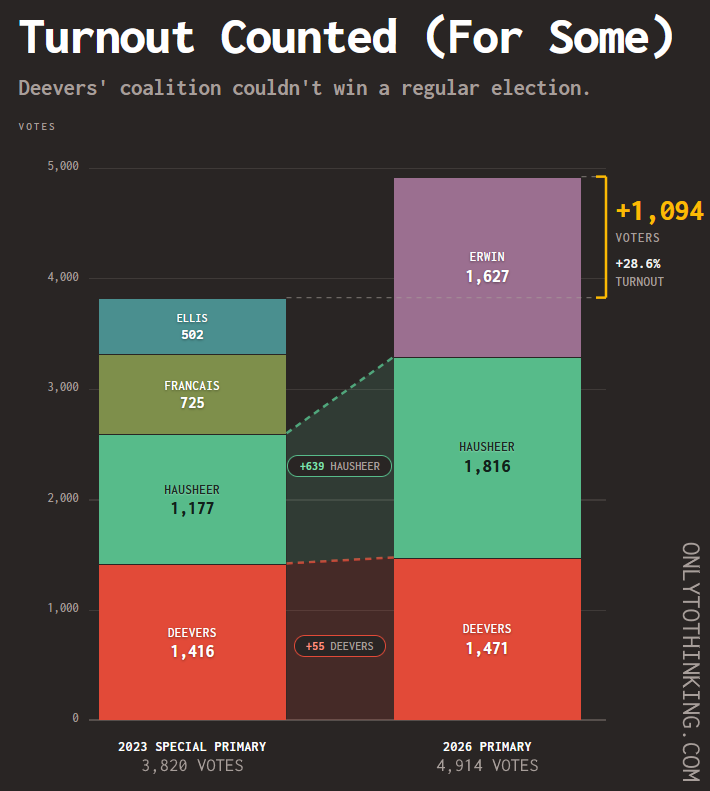
This is just one theory of the case, and it could be wrong, but it’s a theory that’s backed by some political science literature, and, crucially, the election results themselves. While I don’t have the sort of exit poll data that would be necessary to prove such a theory conclusively, it holds up at a glance: Deevers’ number of votes was practically the same as in the last election. Assuming most of the people who voted for Deevers’ last time stuck by him this time, the massive swing towards his opponents would have been primarily driven by new voters, less frequent voters, voters who had perhaps heard Dusty Deevers’ name with reference to any number of his Quixotic bills and marked another name.
The second thing that won Deevers his first election and lost him this election was the strength of his opponents. Last election, there were four candidates, permitting Deevers to take a plurality in a crowded field. Since the election was a special election, his opponents didn’t even have a chance to consolidate around a non-Deevers candidate in the second round. Deevers was able to be the biggest fish in a crowded pond.
In this election though, Deevers was flanked from two sides. On one side, Dr. Jean Hausheer, a conservative Lawton ophthalmologist who lost by just a few hundred votes to Deevers’ in the last election. Smartly, she decided to throw her hat in the ring for round two, and she won big, sweeping the middle class suburbs of west Lawton and chopping Deevers’ margins by more than ten points in many precincts. In the block that contains Ridgecrest Elementary, Deevers’ share of the vote collapsed from 40% to just 25%. While she presents herself as staunchly conservative, she, crucially, does not call herself a Christian Nationalist. She does not name specific policy preferences on abortion. One of her biggest priorities in government will apparently be reforming insurance law. She’s a very different type of conservative than Deevers is: far less ideological and, evidently, far more appealing to a certain type of voter.
On the other flank, Deevers’ faced a new opponent in the form of Curtis Erwin. Curtis Erwin was a truly terrifying opponent for Dusty Deevers and his success is a powerful repudiation of Senator Deevers’ political project. Like Deevers, he is a Republican, Baptist pastor based out of Elgin. Unlike Deevers, Curtis Erwin is not “bought and redeemed by the blood of my Savior and King, Jesus Christ”. He is, instead, a Christian. Whereas Dusty Deevers believes in abortion abolition, Curtis Erwin believes in defending life. Whereas Dusty Deevers believes that the Second Amendment is “an essential safeguard for liberty”, Curtis Erwin wants to stand with law-abiding gun owners. Dusty Deevers’ discussion on affordability begins with the expulsion of immigrants. Curtis Erwin just wants to fight new taxes.
Do you see the differences here? They are subtle, but they are real. One is the rhetoric of a Christian Nationalist who has a Masters of Divinity, and the other is the rhetoric of a Republican politician from Lawton’s most purple Senate seat.
Curtis Erwin is not terrifying for Dusty Deevers’ political project because he presents himself as being more moderate than Senator Deevers. He is terrifying because he won, and not only did he win, he swept Deevers in the very Lawton Exurbs that propelled him to power in the last election, winning in Cache, Fletcher, Indiahoma, and Elgin. Elgin! By 150 votes! He blew Deevers out of the damn water, winning an outright majority on Deevers’ home turf!
Regardless of what anyone thinks about moderation, these are its fruits, and this is what voters think about politicians who go into office with their hearts aflame and their hair on fire. They lose. If he had passed just one bill that he could brag about or tuned the rhetoric down just one degree, it’s possible Deevers could have coasted to re-election off of name recognition alone. But he didn’t, which left him vulnerable to two opponents who could smell his weakness and capitalize on it. Deevers got lucky in 2023, but the system self-corrected as soon as it was possible. If Curtis Erwins’ “Dusty Deevers’ but normal” could win 1,600 votes, then Dusty Deevers, if he were normal, could have easily won the primary. But he didn’t. Because he isn’t.
Conclusion
Dusty Deevers can best be understood as a glitch in the matrix. In a political system designed to produce grounded politicians who are responsive to the demands of their constituents and effective at advancing legislation, and in a district that rewards such moderation and pragmatism more than others, Dusty Deevers coasted into office on low turnout in an off-cycle year against a divided field under unusual election rules, only mildly succeeding in the general where his predecessor had won massively. Once in office, he proved a poor fit for the job for which he was elected, proposing more bills than anyone else in his cohort by far and yet failing to pass even one of them, despite being elected as Vice Chair of the Freedom Caucus. In 2026, facing a larger electorate and stronger opponents with non-overlapping bases of support, Deevers failed to grow his tent.
Earlier, I must concede, I lied. Go ahead, cast the first stone. When Dusty Deevers’ first took office, his first order of business was not to have his assistant begin looking for loopholes in the Constitution. It was his second. His real first order of business was printing out a paper copy of every bill that had been proposed that session for his personal reference. This might sound perfectly reasonable, but it might have actually been the most insane thing he ever did in office for a few reasons:
Bills are amended all the time, and the most current version is always online. His pile of bills was likely rendered obsolete almost the exact moment the ink hit the paper.
Just because a bill is legally alive doesn’t mean it’s actually alive. Most bills do not get heard by committee, and most bills only have a chance of being heard by a committee if they were proposed during the current session. When Dusty printed out every live bill, what he had in fact printed out were mostly loser bills from previous sessions.
The stack of paper was three feet tall. One is shocked he didn’t reconsider his course of action at one foot.
Nonetheless, he continued printing, costing the taxpayer God knows how much money, because, I suppose, he had some deep belief that bills ought to be printed on paper for proper review review by their senator. Upon realizing the extraordinary impracticality of his contraption, Senator Deevers and his assistant stacked the papers on top of a granite counter in the corner of his office where it would remain for the rest of the session.
I tell this story not because it is funny, but because I think it captures something meaningful about who Senator Deevers is and how he thinks. For all of his eccentricities, I believe that Deevers is the embodiment of a couple of fallacies that many people are prone to. On the one hand, he was highly dogmatic in his thinking, inflexible and unwilling to compromise. Some may regard this as a virtue. They may call it “principled” or some other complimentary term, but this does not change that it is extremely annoying and not conducive to the steady functioning of a political system, especially not a democratic one. If every politician in America today were as sure of their beliefs as Senator Deevers is in his, America would have collapsed yesterday.
We can recognize that dogmatism is obnoxious when it is dogmatism with respect to a position we already dislike. The real challenge is developing the empathy to recognize that the dogmas we like are just as obnoxious, just not to us. The challenge of democracy is to recognize and transcend our own biases in order to recognize reality as it is and how others perceive it to be.
The second fallacy is one that’s more broadly dispersed across the population. It’s what I’ll call the “Dave” Fallacy, the idea that, if only we had normal, principled, and commonsensical people in office instead of all these lousy, bickering politicians, we could pretty much solve all these so-called difficult problems. This is a particularly annoying fallacy to me insofar as it is so common, and it’s a fallacy about which Matt Yglesias has written extensively. Passing laws and implementing policies that are broadly good is not impossible. The problem is that we all disagree on what we should fix first, what we’re willing to pay to fix it, and how we should pay for it. Deevers, strutting into office, with all of his principles and his unwillingness to bicker, was completely unwilling to make the trade-offs that would have been necessary to bring our policies even one percent closer to his principles.
So on the occasion of Deevers’ defeat, I propose a toast to normalcy in politics. I propose a toast to backroom committee meetings, bland technocratic changes, and people who don’t say inflammatory nonsense on camera. I propose a toast to a politics of grounded politicians, grounded laws, and grounded policies. I propose a toast, in a word, to the democratic process,
built by ideologues,
to serve the interests of normies,
in the eternal war against ideologues.
Hilariously, this is also the official legal mandate of Iran’s morality police.