

On June 12th, 2020, Trump announced he was on his way to Oklahoma.
2020 is one of the few years in American history that is likely to be remembered, catalogued alongside 1919 and 1968 as among the great years of civic unrest. June of 2020 was the peak of this unrest, the peak of our red-and-black summer. Armed Conflict Location & Event Data (ACLED) recorded over 10,600 demonstrations between May and August of that year, including over 500 that involved violence. Most were a reaction to the murder of George Floyd, with media outlets commonly referring to America’s “racial reckoning” as prestigious publications such as the New York Times published op-eds in support of previously taboo positions such as abolishing the police.
On the first day of June, just over 100,000 people had died of COVID-19. Unemployment had quadrupled from around 3.5% to nearly 14%, and the GDP had declined by 9% in a single quarter. One-third of the population of the United States was living in a state that was enforcing a stay-at-home order in response to the COVID-19 pandemic, and school children across the country were entering their third month without in-person instruction. Businesses across the country were filing claims under the Paycheck Protection Program to avoid laying off their entire workforce, and Americans were reaping the tenuous, short-term benefits of the largest economic stimulus program in the history of this country: eviction moratoriums, student loan relief, expanded unemployment benefits, and individual stimulus checks, sent to millions of American families.
Trump proposed a rally for June 19th for what would be the first mass public gathering in the country since the start of the COVID-19 pandemic in mid-March and the headline event for Trump’s summer campaign. By the eve of the event, almost one million people had requested tickets, and the City of Tulsa was preparing for crowds upwards of 100,000 strong: “We’re back,” thundered an announcement, “We are one movement, one people, one family, and one glorious nation under God.”
The rally would be a disaster.
Trump had first slated the event for June 19th, Juneteenth, in a city that was just starting to come to terms with the 1921 Tulsa Race Massacres. After an outcry from Black leaders and the media, he begrudgingly bumped it to June 20th, awkwardly throwing all twenty-four members of the Black Voices for Trump Advisory Board into the rally as the campaign ran for cover from a hail of negative headlines.
It didn’t seem like anyone actually wanted to take responsibility for the rally. In the week leading up to the rally, ASM Global—the company that manages the BOK Center that played host to the rally—and Tulsa mayor G.T. Bynum entered a bickering match that was as public as it was awkward. In a lengthy Facebook post responding to controversy around the rally, the Republican mayor declared that “I didn’t even know the invitation had been extended until BOK Center management contacted the City regarding Police support for the event.” ASM Global’s Vice President, in an interview released two days before the rally, said that they had been waiting for Bynum to cancel the rally. “That was the answer we were looking for,” he remarked. But Bynum declined to pick up the hot potato, insisting that the booking was purely the operator’s decision, even as he expressed anxiety about the scale of the event. In a last ditch effort to ensure that the rally would be safe from security threats, if not health threats, Bynum imposed a curfew at the request of the Secret Service, only to rescind it a day later after a call with Donald Trump.
When the night finally came, the 19,000-seat arena was packed to the brim with empty seats. The fire department counted just under 6,200 attendees. Turns out most of the 1,000,000 ticket requests the Trump campaign had received in the days leading up to the rally were from teenagers on TikTok and K-pop fans seeking to pull a fast one on an unpopular President. And pull they did. Having planned for a much larger event, a second stage had been constructed outside the Center to accommodate expected overflow attendees. It was dismantled before the speech even started. They were however unprepared for an entirely different type of overflow crowd. During and after the rally, Black Lives Matter demonstrators traded shouts and shoves downtown as police fired pepper balls, with officers even arresting a protestor at the campaign’s request.
The period following the announcement of the rally coincided with the lowest point of the Trump campaign that year, with his average poll numbers not recovering above 41% until the middle of July. At the rally, Trump’s organizers violated BOK Center policy by removing stickers instructing attendees to sit six feet apart. Tulsa city officials reported a record-setting spike in cases following the rally, edging Tulsa’s hospitals ever closer to full capacity. One such rally-spike case may have been that of senior Republican politician and former Presidential candidate Herman Cain. Cain had been invited to the rally in his capacity as the co-chair of the Black Voices for Trump Advisory Board. Cain followed the norms of the rally: he did not social distance. He did not mask. Cain would die of complications relating to COVID-19 a month later.
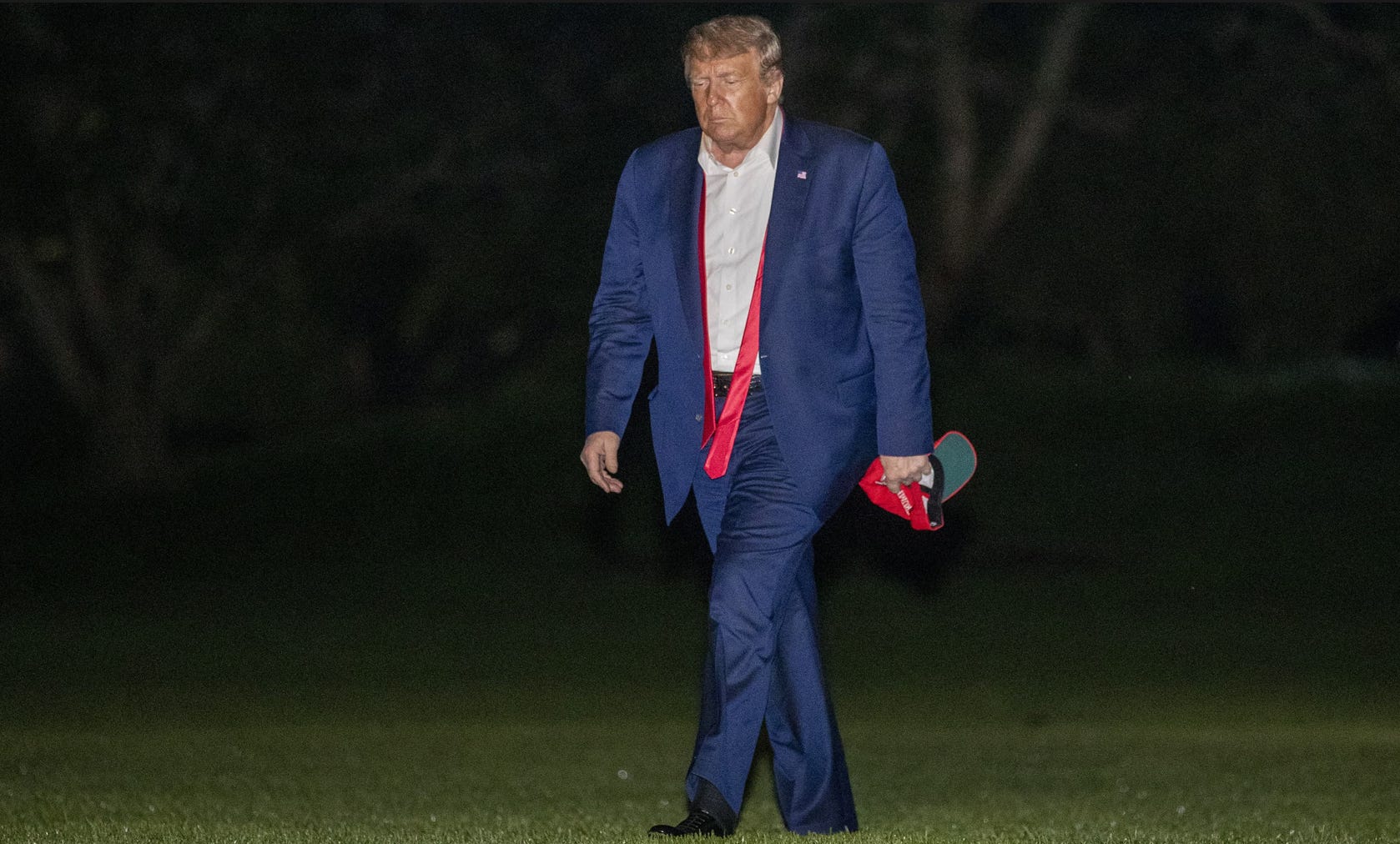
Trump was furious about the rally. It was an embarrassment from the announcement to his own disheveled walk back to the White House. Trump Campaign Manager Brad Parscale would take the fall for the Tulsa imbroglio, replaced within weeks and never again trusted to run a campaign.
However, a scapegoat wasn’t enough. How could it be? One theme of Trump’s first administration was his failures and his scapegoats: his revolving door of cabinet members, senior bureaucrats, and major advisors; his constant fights with Congressional leadership over repealing the Affordable Care Act, funding the border wall, the debt ceiling, and pandemic relief; his power struggles with all the people that are charged—under our customs, our politics, and our Constitution—with checking the power of the President.
A theme of his post-2020 life, perhaps the most important theme, has been his efforts to manage the Republican Party and the federal government of the United States by taking personal control over it. During his cabinet confirmation hearings in 2025, he was clear that his top priority for any potential appointee was personal loyalty, fighting for the confirmation of such diverse and incompetent appointees as Pete Hegseth, Kash Patel, and Tulsi Gabbard. During notable elections of the past few years, Trump has repeatedly opted to endorse candidates whom he believes he could easily control, endorsing figures as unelectable and incompetent as Mehmet Oz, Herschel Walker, and Ken Paxton. He has become laser-focused on purging the Republican Party of unsightly elements, regardless of whether they be neoconservative, libertarian, or just plain skeptical. He shall hold the Republican Party polished as a pearl, reflective as a strip of gold.
This is the context necessary to understand why Donald Trump would endorse Mike Mazzei in the Oklahoma Republican gubernatorial primaries. Trump likes control, and Trump believes he can control Mike Mazzei.
Let’s look at the situation as it was before Trump made his endorsement. NonDoc’s polling indicated it was a neck-and-neck-and-neck-and-neck race between four leading candidates, a sitting Oklahoma Attorney General and old-money rancher, the former Speaker of the House and local banking tycoon, the son of a former governor, and an obscure wet blanket of a former State Senator who hadn’t won an election since 2010. All four candidates were jockeying for Trump’s endorsement in the way that Republicans are apt to do these days. The first candidate, Gentner Drummond, used his position to cut a deal with the administration on voter rolls, compromising voter privacy in Oklahoma. Charles McCall, the second, waxed poetic about how he believed Trump was sent by God to save the United States. Chip Keating, the third, promised to establish a pork barrel project bearing Trump’s name. McCall and Keating both promised to withdraw from the “liberal” National Governor’s Association at Trump’s behest.
While some amateur sleuths suggest that the fourth candidate, Mike Mazzei, used Roger Stone as an intermediary in a scheme to bribe Donald Trump for an endorsement with a paltry $70,000 sum, I don’t find these allegations credible, and a publication with KFOR’s reputation should be embarrassed to be promoting this sort of peasant gossip. In all likelihood, this was regular consulting work that paid the regular rates one would pay for someone with a Wikipedia article and personal rapport with the President.
Likewise, I don’t believe this was a case where Trump simply endorsed the projected winner. Besides the fact Mazzei never outright won a poll until after the endorsement, if he was dispassionate about the specific candidate and simply wanted to claim the winner, there was nothing stopping him from waiting until the inevitable runoff and picking the winner out of a less crowded field. That’s what he did in 2018. But he didn’t: Trump made an endorsement because he actively preferred Mike Mazzei to every other candidate, and he wanted to make sure he advanced to the second round.
Let’s play pretend, for a moment. If you’re Donald Trump, who do you think would be easiest to push around? Would it be three guys who have powerful political machines and deep professional networks, or would it be the guy whose notability was his lack of notability, whose campaign ads inspired one comment on Reddit with 47 upvotes to ask “who the f*** is Mike Mazzei?”
The difference between Mike Mazzei and the rest of these jokers is that they had their own ideas. They could make promises and keep promises. All Mazzei had was money and a good reference. He was easy. He was low-key. A rational control-maximizer could have safely predicted he wouldn’t be a problem. He wouldn’t be going around making embarrassing statements that reflect poorly on the Trump movement, à la Mike Lindell, Marjorie Taylor Greene, or Laura Loomer. He wouldn’t be using Trump’s name to advance his own agenda, à la Elon Musk, Robert F. Kennedy Jr., or Steve Bannon. And most importantly, he would not discover his principles when the President demanded his support, à la Rand Paul, Chip Roy, or, of course, G.T. Bynum. With Governor Mike Mazzei, Trump is betting that when he calls to ask a favor, he’ll already know the reply.
Unlike Mazzei, Drummond, his opponent in the upcoming runoff primaries, has an independent power base here in the state of Oklahoma. One can see this reflected in their endorsement portfolio. Whereas Mike Mazzei has won the endorsement of Donald Trump, Drummond has won the endorsements of 25 sitting members of Oklahoma’s state legislature, 17 County Sheriffs, and seven different state-wide special interest groups, including Oklahomans for Public Education and the Oklahoma Fraternal Order of Police. Early on in the race, he won praise from the Cherokee, Choctaw, and Osage tribal nations for his legal support for tribal autonomy. Mazzei, by contrast, features an endorsement from his own preacher on his campaign website. To paraphrase Mike Mazzei’s most famous endorser: It’s his house! He’s supposed to be there!
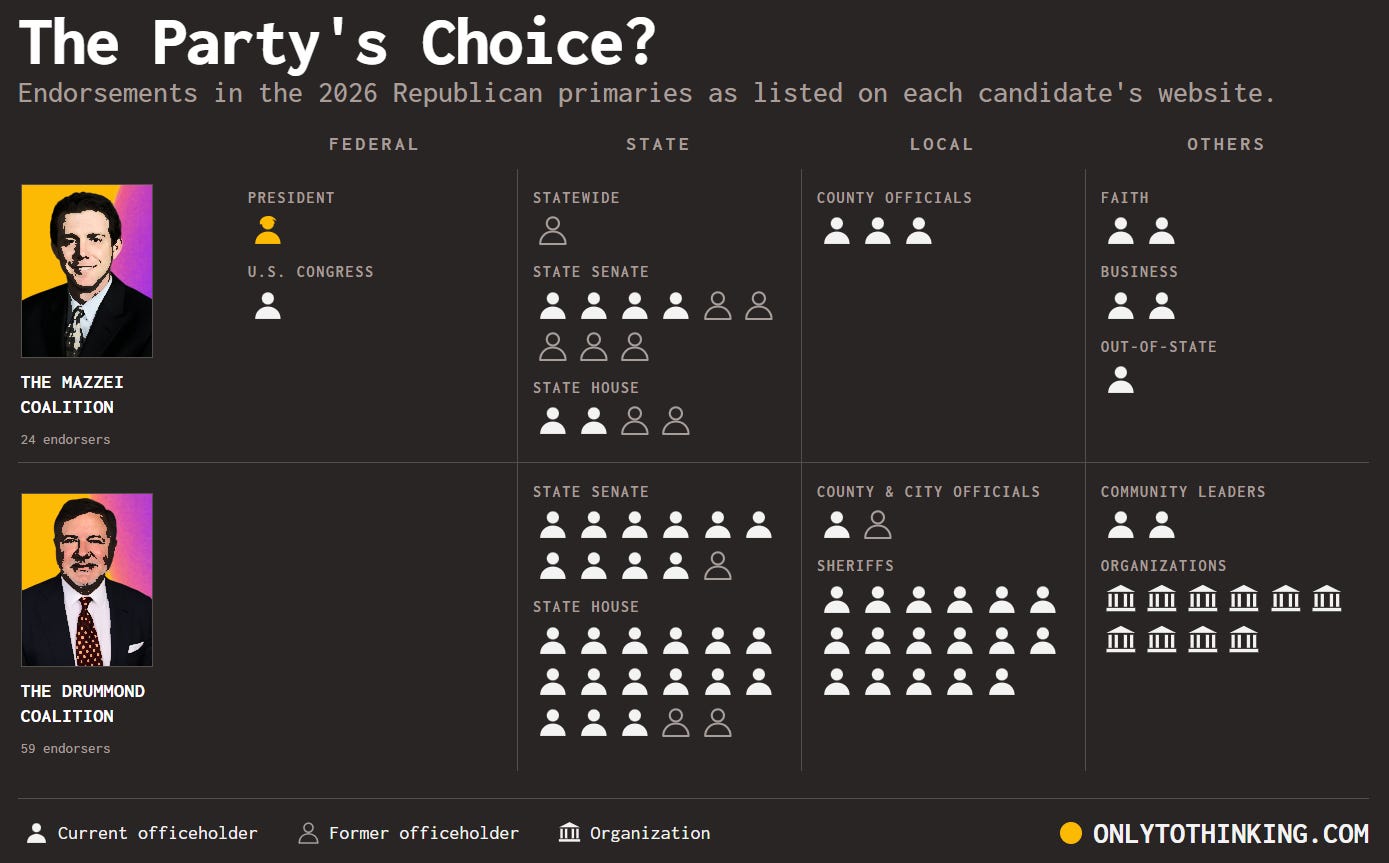
One of the Drummond campaign’s favorite lines is that he’s running “to serve the people of Oklahoma, not the political elite.” This is, of course, somewhat misleading. The choice in this election is between candidates who have the support of two different types of elites. Gentner Drummond has won the support of Oklahoma’s local and state elites, whereas Mazzei has won the endorsement of the biggest elite in the entire world: the President of the United States, the head honcho of the Republican Party, the reluctant leader of the free world.
Following Trump’s endorsement of Mazzei, we watched, in miniature, a control-maximizer’s nightmare. The Drummond machine quickly kicked into gear to punish Trump for his intransigence. First, his office announced that they would be suing a Trump administration-backed aluminum smelter project in eastern Oklahoma, criticizing the project’s environmental impact and its ties with a Persian Gulf petrostate that has become a key Trump ally. In retaliation, Trump took to Truth Social, lambasting Drummond as a “FAKE Republican” and declaring him a “Radical Left Democrat” for refusing to denounce previous impeachment efforts.
A Republican politician with a weaker evaluation of his position (or lower self-esteem) might have retreated to avoid further angering the President or alienating his base. Gentner Drummond remained confident, pivoting his campaign messaging to hammer Mazzei for accepting Trump’s endorsement. Take, for example, this public statement from Drummond’s campaign chair Matt Parker from early June which reads:
Oklahomans know Gentner Drummond is his own man. He doesn’t answer to political consultants, Washington insiders, or special interests.
…
Gentner Drummond has the courage to stand on principle. Mike Mazzei has spent his career changing positions whenever it’s politically convenient. That’s the choice in this runoff.
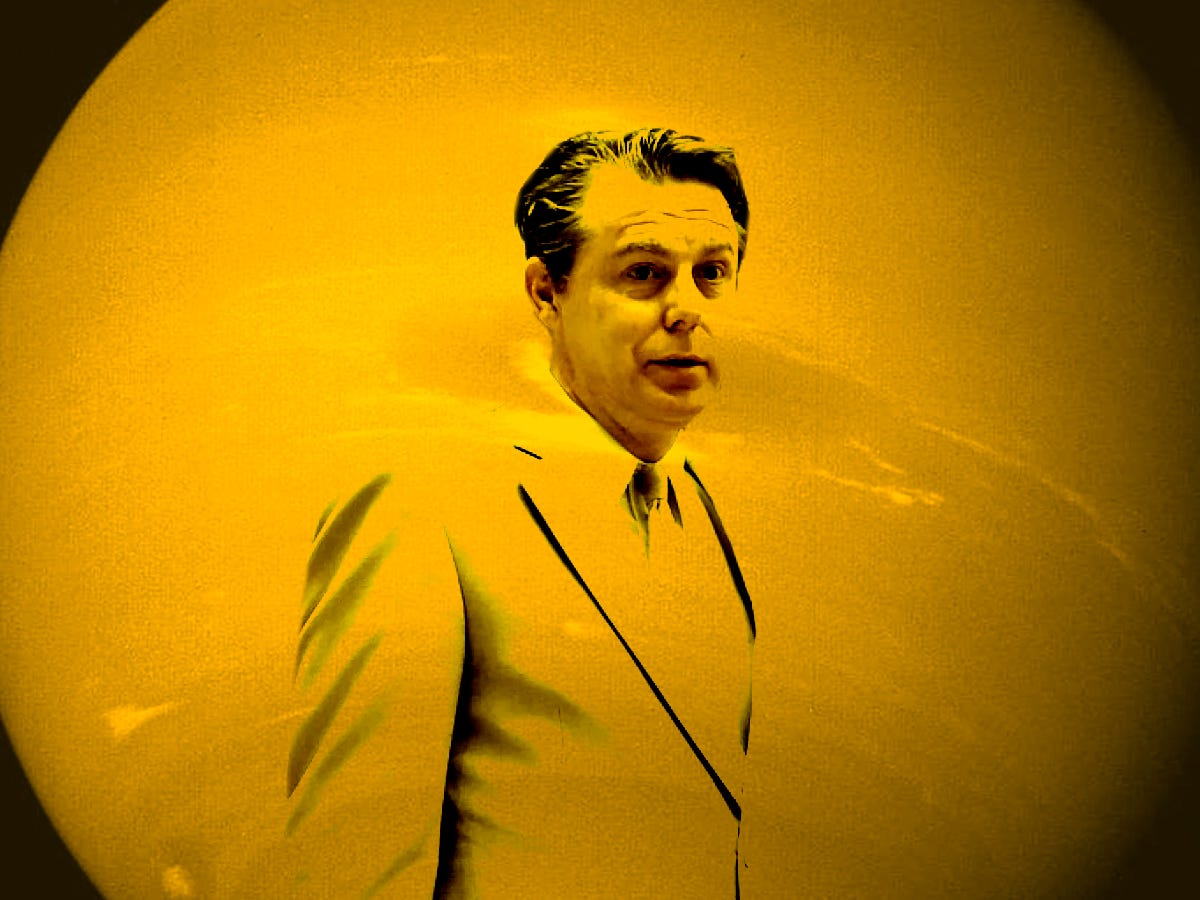
In 1821, Alexis Bouvard hypothesized that the irregular orbit of the planet Uranus could be explained by the existence of another body. In 1846, astronomers observed our eighth planet. When reading this statement, one can sense the presence of a Neptunian body.
Who exactly is Matt Parker referring to when he refers to “Washington insiders?” If Mazzei isn’t “his own man,” whose man is he? With whom are these political consultants doing business that makes them so corrupt? For what political convenience did Mazzei change his principles? Neptune rises in the sky behind us.
There are some (cynics) who argue that there are few meaningful differences between different candidates in different elections, both in terms of how they will perform in any given election and how they will perform in office. I maintain that these distinctions are visible, measurable, and important for understanding democratic politics in a nuanced way, as I argued in previous pieces on the history of Oklahoma’s Democratic Party and a senator from Lawton who lost re-election. Voters tend to notice these differences and act rationally according to their preferences, ill-defined as they often are. There is a long and storied academic literature on voters identifying their preferences through shortcuts and being able to “vote as though they were well informed,” even on obscure or technical matters.
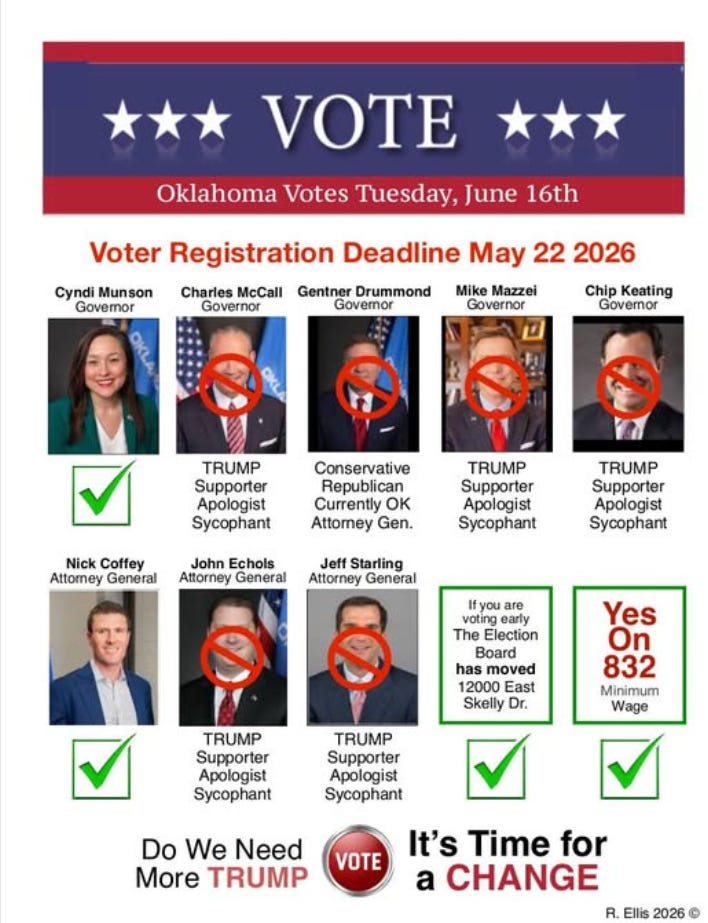
In one fairly cynical piece of propaganda that was being spread by some Oklahoma Democratic partisans last May, I saw someone make an interesting implicit concession. In a graphic that individually labeled every Republican candidate for AG or Governor as a “TRUMP Supporter Apologist Sycophant,” there was one exception: Gentner Drummond was cordially described as “Conservative Republican Currently OK Attorney Gen.”
That is to say that Gentner Drummond is a known quantity. He is a maverick in so far as anyone can afford to be a maverick in this polarized era. He has repeatedly challenged Stitt’s efforts to fight tribal power and publicly fund a private Catholic charter school. When Republican Ryan Walters unceremoniously resigned from his role as Superintendent of Public Instruction following a string of scandals, Drummond called him “an embarrassment to our state.” During the Republican primary, he has faced questions about his loyalty to the Republican Party over his wife’s donations to Joe Biden and the Lincoln Project back in 2020. In one video that acquired some notoriety among a certain type of right-wing activist, he tersely told off a COVID conspiracy theorist who had been harassing his office, saying “I’m a grown-ass adult Attorney General. You don’t have to vote for me. That’s fine. I don’t need your vote.”
To some, this all comes off as evidence of Drummond’s haughtiness, which it is. But I think the more politically salient thing is that it’s evidence of Drummond’s independence. He does not need to bend over backwards to court right-wing conspiracy theorists or unhinged Presidents because he is sure of himself and his people. Mazzei, on the other hand, would owe his governorship to them.
And why would it be better to not have a governor who owes his political life to the current President? I can think of at least three things, all of which are far more important than a failed rally from six years ago.
First, there are the National Guard deployments. This past December, Stitt approved the deployment of around 160 members of the Oklahoma National Guard to Washington D.C. as part of Trump’s mission to clean up one of America’s most visited cities/own the libs. The deployment ran for ninety days. Upon the expiration of the deployment, Trump requested that Oklahoma send another contingent as part of his plans to double the size of the National Guard presence in preparation for America 250 celebrations. Stitt silently declined, apparently deciding that a token display of fealty to Trump was not worth Oklahoman tax dollars. In a more visible spat, Stitt was the first Republican governor to publicly break with Trump over his deployment of Texas National Guard troops to Illinois. These are luxuries that a man with no opportunity for re-election and no interest in higher offices can afford. Should Trump’s attention ever return to the home front, Mazzei’s Oklahoma would doubtless be expected to participate in such operations.
Second, there are the voter rolls. In May 2025, the Department of Justice began writing states to demand that they turn over their complete voter registration lists, complete with names, addresses, birth dates, driver’s license numbers, and partial Social Security numbers. Forty-eight states got the letter; thirty-one refused; five sent public data only; and twelve handed over everything. Initially, Oklahoma was among the holdouts, and it held out until just a few months ago, when Drummond signed a settlement that gave the federal government everything it wanted in exchange for assurances that they would follow the law, even as other Republican AGs in Utah and Kentucky kept fighting and courts were throwing out federal suits against states.
Here are the things that I find most interesting about this story. For one, that Oklahoma settled at all is crazy. Kentucky and Utah, both states with Republican state officials, both refused to settle. Kentucky won its case, and Utah is still fighting. It’s about the clearest evidence that Drummond was seeking a Trump endorsement until he didn’t get one, freeing him to take up more contrarian positions.
This case is a good demonstration of the way that Drummond operates, and it’s going to be important as elections face the prospect of federalization. Despite his later attempt at appeasement, Drummond was not party to the first twelve states who went rushing to give Trump a full service. As governor, the base-less Mazzei would have every reason to give him the full service. Drummond, the man who wasn’t enthusiastic about obliging the first time, would have little reason to continue delivering voter rolls to a man who failed to deliver him an uncontested primary. Independence born of spite is still independence, and once claimed, it’s difficult to rescind.
Finally, and I think most importantly, there is the matter of who will be governing Oklahoma. Whereas Drummond has a homegrown political base that he could depend upon to deliver him consistent majorities in the House and Senate, Mazzei’s most important supporter is more than a thousand miles away. This is fine for a campaign, but once he takes office, it’s going to become a liability. His primary endorsers from this state are retired Senators whom he knew from way back when. Those guys aren’t the ones he’ll need pressing the green button come next session.
Mazzei might initially be able to use his productive relationship with Trump to secure some benefits for Oklahoma—Trump has a long history of this sort of patronage, after all. However, this relationship is a depreciating asset. Once Trump leaves office, or worse yet, if Trump simply loses his majority in the House and Senate, Mazzei becomes the puppet of a lame duck: the worst of all possible worlds. Trump would be able to make demands (lest Mazzei risk losing his most valuable political patron) and Mazzei wouldn’t even be able to collect anything for it, besides donations to his own campaign war chest. This situation only worsens, of course, as time goes on. Trump’s second term expires in January 2029.
What happens then to a governor whose strongest qualification was his willingness to pledge fealty to a man who is no longer the President? Trump doesn’t care about the answer to this question. He doesn’t even care about questions of governing ability with respect to his own cabinet picks.
But we do, or at least we should. The choice of who will become governor next January is a question that will affect everyone in Oklahoma for a long time to come. The last four governors have each served two terms in office, which means that our operational assumption for this coming November should be that whoever takes office in 2027 won’t be leaving office until the mid-2030s.
In other words, we’re making a long-term investment here, and I believe that it is important, in this upcoming primary, that Republican voters evaluate each candidate according to their merits.
For my part, I will be casting my vote for Gentner Drummond. I like that, in an era of lawlessness in government and deinstitutionalization, he has flexed the powers of the AG’s office. I like that he has an independent streak and a limited patience for charlatans from the extremist wings of his party. I like that, when he enters office, he will not be in debt to an aging King, but collecting interest from his productive relationships with members of the legislature.
Mazzei is a perfectly defensible choice for governor on his own merits. I privately put him at #3 out of 5 when evaluating my personal favored pick for Republican nominee last May. I neither liked nor disliked him at first look. He has extensive budgetary experience in the depths of the system, and he isn’t a right-wing nut.
However, I question whether eliminating property taxes for America’s wealthiest age cohort is the best way to remedy the problems that face Oklahoma today. I’ll put it this way: between retirees and young college graduates, who will be the ones to turn Oklahoma into a top ten state? Between young professionals and old widows, who will be the ones building companies, working full-time jobs, and raising the next generation of Oklahomans, and who will be collecting a cost-of-living adjusted welfare check in the mail each month? A lower tax ceiling will mean that something has to give: either the people of Oklahoma who still work will be chipping in more, or school children will be getting less. A gentleman with Mazzei’s background knows perfectly well that there are no free lunches, and clever accounting doesn’t change that.
I fear that this guy would be more concerned about ensuring the happiness of his Washington handlers than his constituents. I fear that my friends in the Oklahoma National Guard will be caught up in the hare-brained schemes of a delusional old President. I fear that an administration led by people with a record of rejecting election results might not be trustworthy trustees of Oklahoma’s voter rolls. I fear the repercussions if the incumbent administration stumbled into yet another data security incident, this one involving the last four digits of every Oklahoman’s Social Security number.
It is my view that Drummond is the better man for the job: more independent and more able to defend Oklahoma’s interests. In 2020, we saw what happens when Trump calls and we hedge. The next call won’t be about a curfew.
When that phone rings again,
I want a governor able to pick it up
and say “no.”
Excellent piece, Brayden! A little tangential, but you motivated me to look at the last several gubernatorial elections in Oklahoma, and to my surprise, they've been close every cycle since 2014.
Okay, maybe not close per se, but in a state as red as Oklahoma, it's interesting that Dems usually surpass 40% of the vote in gubernatorial races (even in red midterm years such as 2014 and 2022).
Does this boost your engagement?